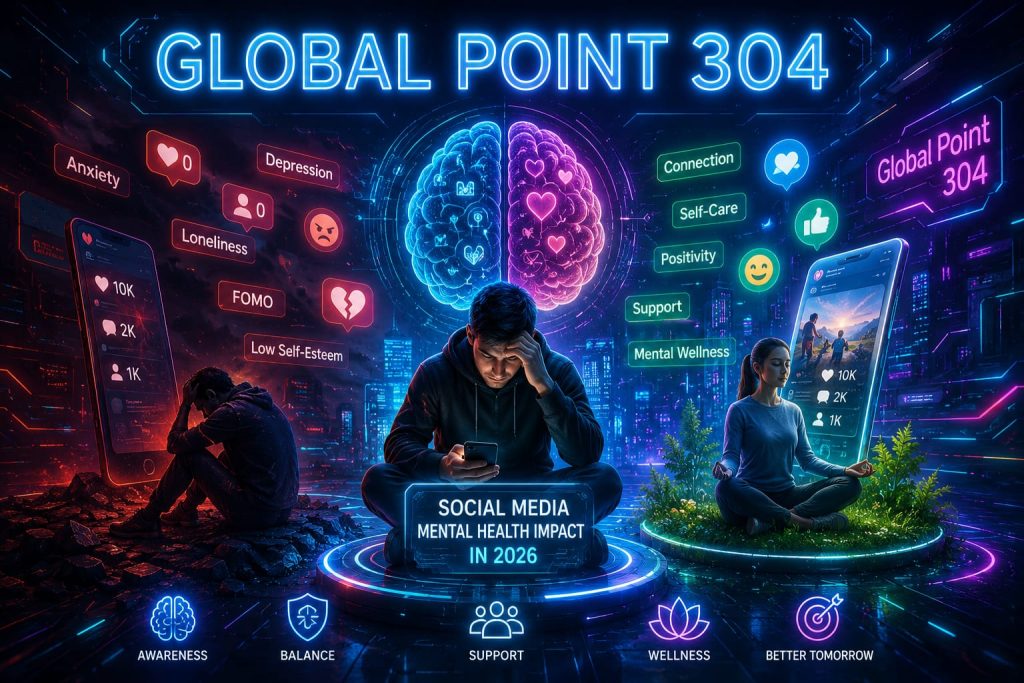
Social Media Mental Health Impact 2026: Shocking Reality
Social media mental health has become one of the most searched, most debated, and most misunderstood topics of 2026. Almost everyone with a smartphone spends hours scrolling through Instagram, TikTok, Facebook, and X every single day — and almost everyone has, at some point, wondered whether that habit is quietly reshaping their mood, their sleep, and their sense of self-worth. This is no longer a niche concern for psychologists. Social media mental health is now a mainstream public health conversation, discussed by governments, universities, doctors, and parents alike.
In this in-depth guide, we break down what the newest 2026 research actually says about social media mental health, who is most affected, which platforms carry the highest risk, and — most importantly — how you can protect your own mental wellbeing without giving up the digital connections that matter to you. This article is part of Global Point 304’s ongoing Social Reforms coverage, where we regularly explore how technology is reshaping everyday life for Pakistani readers and the global audience alike.
Why Social Media Mental Health Is Such a Big Conversation in 2026
The link between social media mental health and daily wellbeing has grown stronger, not weaker, over the past few years. According to Pew Research Center data cited by public health researchers in 2026, the vast majority of adults and an even larger share of teenagers now use at least one social platform daily. That level of exposure means even small negative effects on social media mental health can add up to a massive impact across an entire population.
Universities including Yale and Johns Hopkins have launched fresh research initiatives in early 2026 specifically dedicated to untangling the relationship between screen time and psychological wellbeing. Their early findings suggest that the social media mental health conversation is more nuanced than “more use equals more harm.” Instead, researchers are finding that *how* people use social media — passively scrolling versus actively connecting — matters just as much as *how much* they use it.
The Numbers Behind Social Media Mental Health in 2026
Recent studies paint a mixed but concerning picture of social media mental health trends:
- Longitudinal research on children aged 9–10 found that increasing daily social media use from around 7 minutes to over an hour was linked to a significant jump in depressive symptoms within three years — a striking data point for anyone thinking about social media mental health in younger children.
- Over half of teenagers report feeling anxious or depressed after using social media, and roughly 4 in 10 Gen Z users say platforms make them feel sad or anxious.
- Nearly half of teens now say social media has a negative effect on people their age — almost double the number who said the same just a few years earlier, showing how quickly public perception of social media mental health is shifting.
- A large UK longitudinal study of over 15,000 adults found that high viewing combined with high posting activity was associated with worse mental health scores a year later.
- On the other hand, over half of respondents in newer surveys say social media has positively strengthened their relationships with friends and family — a reminder that social media mental health outcomes depend heavily on context and usage style.
This is the core tension at the heart of every social media mental health discussion in 2026: the same app that helps a teenager in a small town find a supportive community can also be the source of comparison, anxiety, and sleepless nights for another user just a few scrolls later.
How Social Media Affects Mental Health: The Negative Side
When people talk about social media mental health risks, a few patterns come up again and again in the research:
1. Anxiety and Constant Comparison
Platforms like Instagram and TikTok are built around curated, highly edited images of other people’s lives. Repeated exposure to these idealized posts is one of the most consistent findings in social media mental health research, with users — especially young women — reporting higher body dissatisfaction and self-esteem issues the more time they spend comparing themselves to others online.
2. Sleep Disruption
Late-night scrolling is a major contributor to poor social media mental health outcomes. Blue light exposure combined with the emotional stimulation of endless content keeps the brain alert long after it should be winding down, leading to shorter and lower-quality sleep — which in turn worsens mood, focus, and anxiety the next day.
3. The “Dopamine Loop” and Addictive Design
Every like, comment, and share triggers a small dopamine hit. Social media platforms are intentionally engineered around this feedback loop, and researchers studying social media mental health increasingly describe this pattern using the language of behavioral addiction. Teens who received fewer likes or less positive feedback on their posts reported feeling more rejected and had more negative thoughts about themselves.
4. Cyberbullying and Social Comparison
The CDC’s Youth Risk Behavior Survey linked frequent social media use to higher rates of bullying, both online and in person, along with increased feelings of sadness and hopelessness among high school students. This is one of the darker sides of social media mental health that policymakers are now treating as an urgent public health issue.
5. App-Switching and Platform Overload
Interestingly, some 2026 research shows that people who use between 7 and 11 different social media apps were three times more likely to report symptoms of depression or anxiety compared to more selective users. This suggests that the sheer volume of platforms a person juggles is itself a social media mental health risk factor, independent of total screen time.
The Positive Side of Social Media Mental Health
It would be inaccurate — and unhelpful — to present social media mental health as a purely negative story. The research consistently shows real benefits too:
- Over 80% of students report that social media boosts their sense of connection to others, which is a meaningful protective factor for social media mental health, especially for people who feel isolated in their offline environment.
- During periods of isolation, messaging and video calls have helped people — especially the elderly — stay socially connected, which research links to better cognitive and emotional outcomes.
- Online communities give people in remote or underserved areas access to mental health information and peer support they might never find locally, an especially relevant point for social media mental health in developing regions like Pakistan.
- Purposeful, intentional social media use — messaging close friends, joining supportive communities — is linked to noticeably better emotional outcomes than passive, endless scrolling.
This is why experts increasingly frame the social media mental health debate not as “social media is good” versus “social media is bad,” but as a question of *how* it is used. A 30-minute video call with family abroad has a very different effect on social media mental health than 30 minutes of comparing yourself to influencers.
Social Media Mental Health Across Different Age Groups
Children and Pre-Teens
This is the age group where social media mental health research shows the clearest cause for concern. Brain development, identity formation, and emotional regulation are all still in progress, which makes children more vulnerable to comparison, validation-seeking, and addictive app design.
Teenagers
Teen social media mental health has become the most heavily studied area, partly because the U.S. Surgeon General formally called youth social media use an urgent public health issue. Teens with pre-existing anxiety report significantly more emotional impact from social media than their peers without anxiety, suggesting that vulnerable teens need extra protection and monitoring.
Adults
Adult social media mental health outcomes are shaped heavily by usage patterns — passive scrolling through news and other people’s highlight reels tends to correlate with worse outcomes than active, two-way communication with real friends and family.
Older Adults
Interestingly, one long-running Norwegian health study found that social media use helped offset some of the mental and cognitive decline linked to social isolation in older adults during recent years — a rare example of social media mental health research pointing toward a clearly protective effect for a specific age group.
Social Media Mental Health in Pakistan: A Local Perspective
While most large-scale social media mental health studies come from the US, UK, and Europe, the underlying patterns are increasingly visible in Pakistan too. Smartphone and social media penetration has grown rapidly across Pakistani cities and towns, and platforms like TikTok, Instagram, Facebook, and WhatsApp now play a central role in how young Pakistanis socialize, learn, and form their sense of identity.
At the same time, Pakistan faces unique social media mental health challenges: limited access to mental health professionals, cultural stigma around discussing anxiety or depression openly, and heavy reliance on social media as a primary source of entertainment and news. This makes local awareness campaigns and accessible information about social media mental health especially important. Global Point 304 has made youth-focused digital wellbeing one of its ongoing Social Reforms priorities — you can read our earlier deep dive on this subject in our dedicated article on youth mental health and social media, which looks specifically at how younger users are affected and what families can do about it.
Warning Signs of Poor Social Media Mental Health
Recognizing the early signs of a social media mental health problem can make a real difference before things get worse. Watch out for:
- Feeling anxious, irritable, or empty after closing an app
- Comparing your body, lifestyle, or achievements to others constantly
- Checking your phone first thing in the morning and last thing at night
- Losing sleep because of late-night scrolling
- Feeling like you need to check notifications even during work, study, or family time
- A noticeable drop in mood tied directly to likes, comments, or follower counts
None of these signs alone means someone has a serious social media mental health issue, but a pattern of several of them together is worth taking seriously — and worth discussing with a trusted friend, family member, or mental health professional.
Practical Tips to Protect Your Social Media Mental Health
- Set daily time limits. Built-in screen time tools on both Android and iOS can cap your daily social media use and send reminders when you go over.
- Curate your feed intentionally. Unfollow or mute accounts that consistently make you feel worse about yourself. This single step has one of the biggest measurable effects on social media mental health.
- Turn off non-essential notifications. Every buzz is a small hook pulling you back into the app.
- Create phone-free zones. Keep phones out of the bedroom to protect sleep quality, which is closely tied to social media mental health outcomes.
- Favor active over passive use. Message a friend directly instead of just scrolling through their story — active engagement is consistently linked to better social media mental health than passive consumption.
- Take a full digital detox day. One offline day a week can meaningfully reset your relationship with your feed.
- Talk about it. Whether it’s with friends, family, or a professional, openly discussing struggles with social media mental health reduces stigma and often reveals that you’re far from alone.
The Role of Algorithms and AI in Social Media Mental Health
One of the biggest shifts in the 2026 social media mental health conversation is growing scrutiny of the algorithms themselves. Recommendation systems are explicitly designed to maximize watch time and engagement, not user wellbeing. Public health experts at institutions like Johns Hopkins have specifically flagged algorithmic design — not just screen time — as a core driver of social media mental health harms, particularly the way algorithms can push vulnerable users toward increasingly extreme or emotionally charged content.
Some platforms have introduced wellbeing-focused features in response — usage reminders, “take a break” prompts, and content warnings — but researchers note these tools are often optional and easy to ignore, meaning the responsibility for protecting social media mental health still largely falls on individual users and families.
Frequently Asked Questions About Social Media Mental Health
Is social media bad for mental health?
Not universally. Research on social media mental health shows a mixed picture — passive scrolling and constant comparison tend to harm wellbeing, while active, purposeful connection with real friends and communities can genuinely help.
How many hours of social media use is considered risky for mental health?
Several 2026 studies link three or more hours of daily use to higher anxiety symptoms, though the *type* of use matters as much as the total time when it comes to social media mental health.
Which age group is most affected by social media and mental health issues?
Teenagers and pre-teens show the clearest and most consistent social media mental health risks, largely due to ongoing brain and identity development.
Can social media ever improve mental health?
Yes. Supportive online communities, family video calls, and access to mental health information can have a genuinely positive effect on social media mental health, particularly for isolated or underserved individuals.
Final Thoughts
Social media mental health is not a simple story of “good app” or “bad app.” It’s a story about design, habits, and awareness. The platforms are not going away, and for most people, quitting entirely isn’t realistic or even desirable — social media offers real connection, information, and community. The goal isn’t to eliminate social media from your life, but to use it in a way that protects rather than damages your social media mental health.
At Global Point 304, we’ll continue tracking new research and practical guidance on social media mental health as part of our ongoing commitment to Social Reforms coverage for our readers. If you found this useful, don’t forget to check our related article on youth mental health and social media for a deeper look at protecting younger users.
Sources: Pew Research Center, U.S. Surgeon General’s 2023 Advisory, CDC Youth Risk Behavior Survey, Yale Child Study Center, Johns Hopkins Bloomberg School of Public Health, and peer-reviewed studies published via NCBI/PubMed Central.