
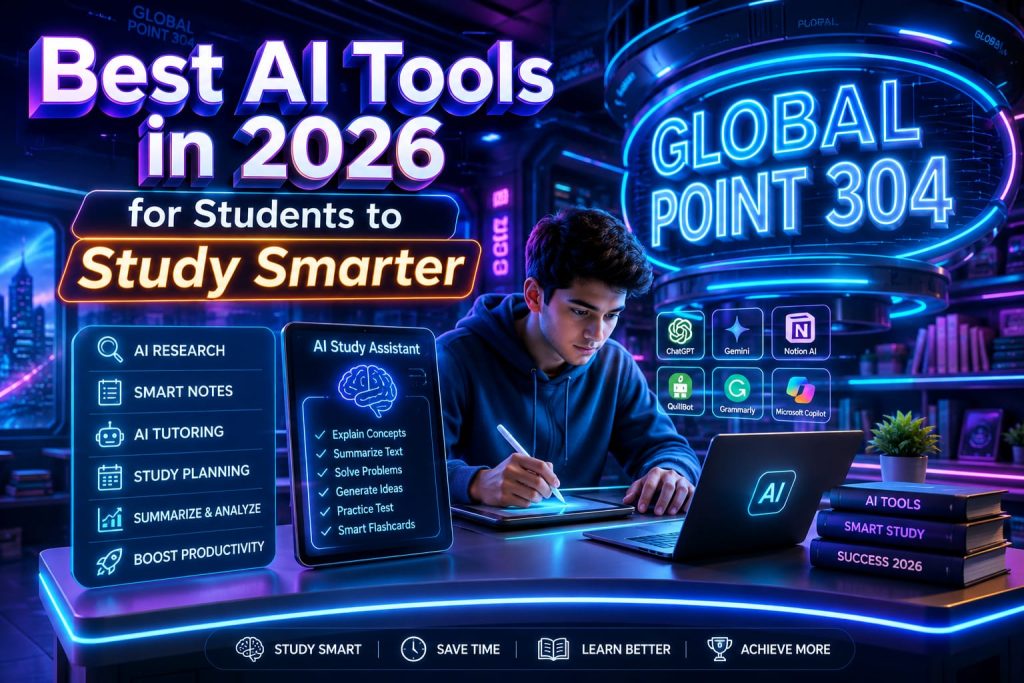
Best AI Tools for Students in 2026: Study Smarter, Not Harder
Every year, students are told to “study smarter, not harder,” but in 2026 that advice finally has real substance behind it. Thanks to the explosion of AI tools for students, learning is no longer limited to textbooks, tuition centers, and late-night cramming. From writing assistants to flashcard generators, today’s study apps can summarize a 40-page PDF in seconds, turn messy lecture notes into a clean study guide, and even quiz you before an exam like a personal tutor who never gets tired.
If you are a school student, a college undergrad, or preparing for competitive exams here in Pakistan, this guide will walk you through the best AI tools for students in 2026, how to use them responsibly, and how to avoid the common mistakes that get students into trouble with plagiarism checkers and academic integrity policies.
Why AI Tools for Students Matter More Than Ever in 2026
The demand for smart study apps has grown sharply because education itself has changed. Classes are more content-heavy, competition for admissions and scholarships is fiercer, and students juggle part-time work, tuition, and family responsibilities alongside their studies. In this environment, the right AI tools for students don’t replace effort, they remove the repetitive, time-consuming parts of studying so you can focus your energy on actual understanding.
Think of it this way: a good set of these apps handles the admin work of learning, organizing notes, drafting outlines, generating flashcards, checking grammar, so your brain is free to do the part that actually builds knowledge: thinking, questioning, and practicing.
How to Choose the Right AI Tools for Students
Not every tool marketed as an educational app is worth your time. Before adding any app to your study routine, ask these questions:
- Does this tool actually save time, or just add another app to check?
- Is there a genuinely useful free plan, or is it locked behind a paywall?
- Does it work well on a low-end Android phone, since most students in Pakistan study on mobile data?
- Does it help you understand the material, or does it just hand you finished answers?
Keeping these questions in mind will help you build a personal stack of study tools that actually improves your grades instead of becoming a distraction.
Best AI Tools for Students: Writing, Research and Explanation
This category is where most students start, and for good reason. These apps act like a study partner who is available 24/7.
ChatGPT remains one of the most widely used AI tools for students for brainstorming essay ideas, breaking down difficult concepts, and getting a second explanation when a textbook definition just isn’t clicking. Visit OpenAI’s ChatGPT page to see current plans and features.
Google Gemini is built directly into many Android phones and Google Workspace, which makes it one of the most convenient options for students who already use Gmail, Docs, and Google Search daily. Check it out at gemini.google.com.
Perplexity AI deserves a special mention among research assistants, because it cites its sources directly in the answer, which makes it far easier to double-check facts before including them in an assignment. Explore it at perplexity.ai.
We actually explored how AI-based search is changing the way students and everyday users find information in our earlier post, AI Search vs Google Search in 2026, which is worth reading if you want to understand how these research tools fit into the bigger search landscape.
Best AI Tools for Students: Notes and Lecture Summaries
Taking notes by hand during a fast-paced lecture is hard, and this is exactly the gap that AI note-taking apps were built to fill.
NotebookLM by Google lets you upload your own lecture slides, PDFs, and readings, then ask direct questions about that specific material instead of getting generic internet answers. It has become one of the most trusted options because it sticks closely to your own source material. See more at notebooklm.google.
Otter.ai records and transcribes live classes automatically, then generates a summary you can search by keyword later. For students who struggle to write and listen at the same time, this is one of the most practical AI tools for students available today. Visit otter.ai.
Notion AI combines note organization with an AI assistant that can summarize pages, generate to-do lists, and clean up messy notes into a structured format, making it a favorite among students who like keeping everything in one workspace. Learn more at notion.so.
Best AI Tools for Students: Flashcards and Active Recall
Research on memory consistently shows that active recall and spaced repetition beat passive re-reading, and this is where flashcard-based AI tools for students shine.
Quizlet now uses AI to automatically turn your notes or textbook chapters into flashcards and practice tests, saving hours of manual card-making. It remains one of the most popular choices for exam preparation. Try it at quizlet.com.
Anki, paired with AI-assisted add-ons, is still favored by medical and law students because of its powerful spaced-repetition algorithm, making it one of the more advanced options for tackling heavy memorization subjects.
Best AI Tools for Students: Math, Science and Problem Solving
Wolfram Alpha continues to be one of the most reliable AI tools for students tackling math and science, because unlike general chatbots, it performs actual calculations instead of guessing. This makes it far more accurate for calculus, statistics, and physics problems. Visit wolframalpha.com.
Photomath lets students scan a handwritten or printed math problem and instantly get a step-by-step solution, which makes it one of the most beginner-friendly options for students who need to understand the “how,” not just the final answer.
Best AI Tools for Students: Essay Writing and Grammar
Grammarly checks grammar, tone, and clarity in real time, and its AI suggestions have made it one of the most trusted AI tools for students for polishing assignments before submission. Visit grammarly.com.
QuillBot helps paraphrase and restructure sentences in your own words, which is useful for students who understand a concept but struggle to express it clearly, making it a smart addition to any student’s toolkit for better writing.
Best AI Tools for Students: Study Planning
Good grades depend heavily on time management, and study-planning apps like MyStudyLife help by scanning your timetable, tracking assignment deadlines, and sending reminders before exams sneak up on you. This category of AI tools for students often gets overlooked, but it quietly saves the most time over a full semester.
Free vs Paid AI Tools for Students
Most of the apps listed above offer a genuinely useful free tier. Our advice: start with free plans for at least a month before paying for anything. Upgrade only when a specific paid feature, like unlimited document uploads or faster processing, is clearly saving you real study time.
Risks and Academic Integrity When Using AI Tools for Students
Not every use of these apps is appropriate for every assignment. Many universities now use plagiarism and AI-detection software, and submitting AI-generated text as entirely your own work can lead to serious academic penalties. The safest approach is to use AI tools for students for brainstorming, summarizing, and checking your understanding, while writing your final submissions in your own words. Always check your institution’s specific policy on AI use before an assignment is due.
How Global Point 304 Covers AI Tools for Students
At Global Point 304, we regularly compare and test AI tools for students, from AI chatbots to AI search platforms, so that our Pakistani readers can make informed choices without wasting time or mobile data on apps that don’t deliver. If you want to understand how AI-powered search itself is reshaping how students find answers, our detailed comparison in AI Search vs Google Search in 2026 is a great next read.
Frequently Asked Questions
Are AI tools for students free to use?
Most major options, including ChatGPT, Gemini, Quizlet, and Grammarly, offer solid free plans that cover the essentials most students need.
Can these tools replace teachers?
No. The best AI tools for students support learning and save time on repetitive tasks, but they cannot replace the guidance, feedback, and motivation a real teacher provides.
Which apps work best on mobile phones?
ChatGPT, Gemini, Quizlet, and Photomath all have lightweight, mobile-friendly apps, making them practical choices for students studying primarily on their phones.
Is it safe to use these apps with personal data?
Reputable AI tools for students like ChatGPT, Gemini, and Grammarly are generally safe, but you should avoid entering sensitive personal or family information into any AI chatbot.
Final Thoughts
The right combination of AI tools for students can genuinely transform how you study, cutting hours of repetitive work while helping you understand material more deeply. The key is balance: let AI handle the busywork, but keep the actual thinking, writing, and problem-solving in your own hands. Used this way, these tools become a real advantage rather than a shortcut that hurts your learning in the long run.