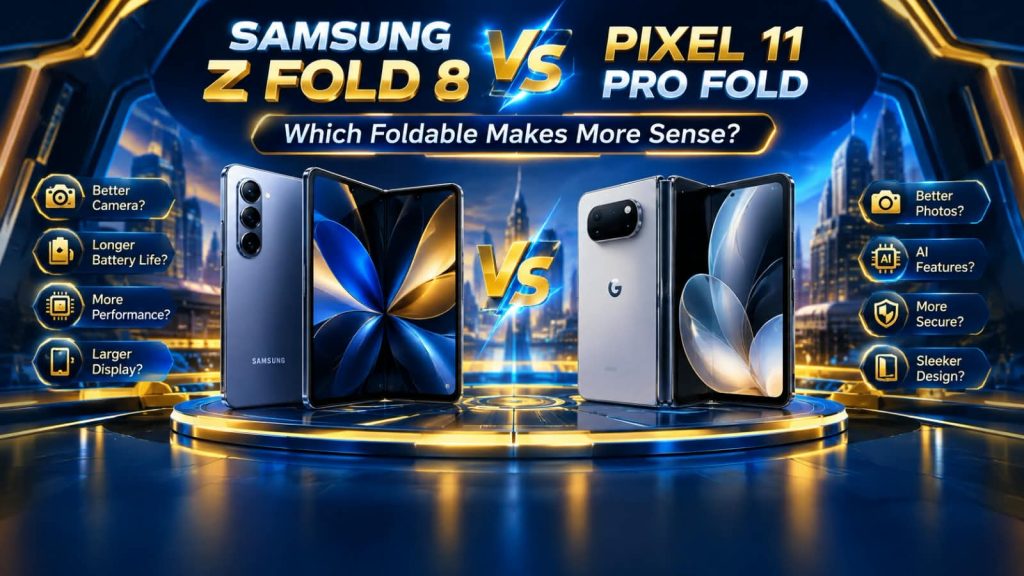
Two of the most talked-about foldables of 2026 are going head to head, and the Samsung Galaxy Z Fold 8 vs Pixel 11 Pro Fold question is not as simple as it looks
One phone wants to be your pocket workstation. The other wants to be the smartest Android phone you have ever held
Let’s work out which one fits your life
A few years ago, foldable phones felt like expensive experiments. Today they are serious flagships
Students use them to read PDFs. Freelancers use them to answer emails on the go. Creators use them to edit, caption and post from a train seat
That is why the Samsung Galaxy Z Fold 8 vs Pixel 11 Pro Fold comparison matters so much this year. Both phones sit at the very top of the market, and both cost real money
Samsung has spent years polishing the book-style foldable. Its Galaxy Z Fold line is known for a big inner screen, strong multitasking, S Pen support and a mature software experience
Google takes a different road. The Pixel Fold idea leans on clean Android, Gemini AI, computational photography and everyday simplicity
So which one deserves your savings? The honest answer is: it depends on how you use your phone
In this guide we look at design, displays, performance, cameras, software, AI, battery, charging and value. We are not here to crown a winner just for the sake of it. We want you to pick the foldable that actually suits your routine
Please note: Specifications, software features, pricing and availability can change by market and final retail version. Always confirm the latest details with the manufacturer or an authorized seller before you buy
In this article
- Quick comparison table
- Design and build quality
- Display experience
- Performance
- Multitasking, S Pen and productivity
- Camera comparison
- AI and smart features
- Software, battery and charging
- Gaming, creators and daily use
- Durability, price and value
- Who should buy which phone
- Final verdict and FAQs
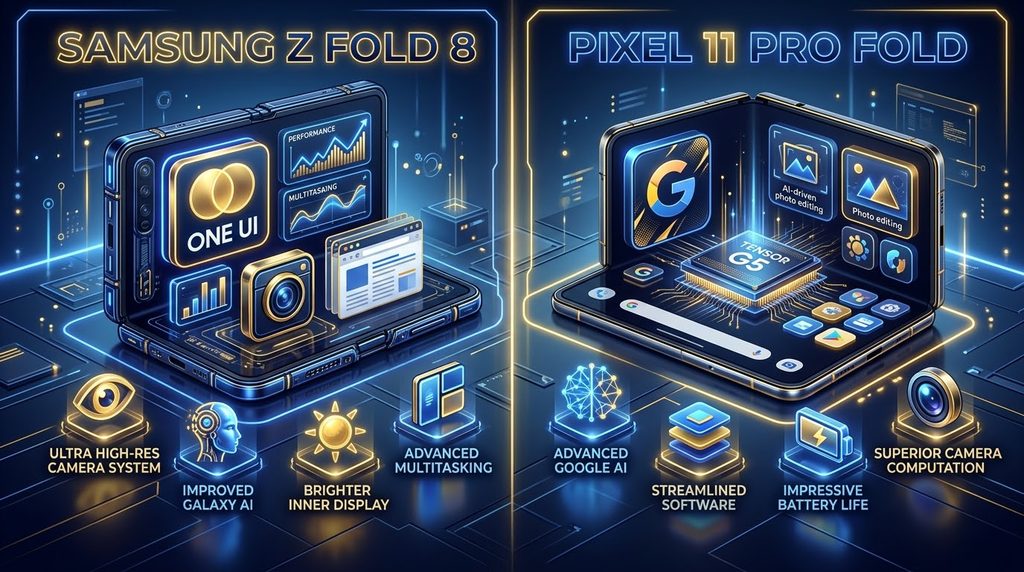
Samsung Galaxy Z Fold 8 vs Pixel 11 Pro Fold: Quick Comparison
Here is the big picture before we go deeper into the Samsung Galaxy Z Fold 8 vs Pixel 11 Pro Fold details
| Feature | Samsung Galaxy Z Fold 8 | Pixel 11 Pro Fold |
|---|---|---|
| Inner display | Dynamic AMOLED 2X, 120Hz | LTPO OLED, 120Hz |
| Cover display | 6.3-inch | 6.3-inch |
| Processor | Snapdragon 8 Gen 5 for Galaxy | Google Tensor G6 |
| Main camera | 50MP | 48MP |
| Ultrawide | 12MP | 10.5MP |
| Telephoto | 10MP | 10.8MP |
| Software | One UI 8 | Stock Android 17 |
| AI focus | Galaxy AI and productivity | Gemini AI integration |
| Multitasking | Multi-window, Taskbar, DeX | Clean Android multitasking |
| Stylus | S Pen support | More software focused |
| Charging | Wired, wireless, reverse wireless | Wired and Qi2 wireless |
| Best for | Productivity and power users | AI, camera and simplicity |
On paper, both phones live in the same premium neighborhood. Their priorities, though, are very different
That difference is the heart of the Samsung Galaxy Z Fold 8 vs Pixel 11 Pro Fold battle
Design and Build Quality
Building a foldable is much harder than building a normal phone
You need a flexible display, a strong hinge, protective layers and two halves that move together without drama. Every extra part is another thing that must survive years of opening and closing
Samsung has a long head start here. The Galaxy Z Fold 8 continues the brand’s focus on a refined hinge, premium materials and a compact shape when folded. The inner crease is reported to be subtle, and the structure feels rigid
That matters because the hinge is the soul of any foldable. If it feels cheap, the whole phone feels cheap
Samsung also builds its devices around multiple postures: closed, open and half-folded. Its developer resources for Galaxy Z devices explain features like app continuity and Flex Mode, which show how seriously the company treats the folding experience
Google’s Pixel 11 Pro Fold goes in a slightly different direction. Rounded corners, a matte-style finish and a flatter closed profile make it feel more like a regular smartphone
That can be a big deal. A foldable is not open all day
You check notifications while walking. You reply to a message at a bus stop. You make a quick call or open a banking app without unfolding anything
So the outer screen is not a side feature. It is the screen you will use most often
Design verdict: If you value mature foldable engineering, Samsung has the stronger case. If you want a familiar phone feeling when the device is closed, the Pixel is easier to love
Display Experience
The display is the main reason people buy a foldable. You are paying extra to get two screens in one device
In the Samsung Galaxy Z Fold 8 vs Pixel 11 Pro Fold display battle, both phones aim for flagship quality. Their strengths simply speak to different people
The Galaxy Z Fold 8 uses a Dynamic AMOLED 2X inner panel at 120Hz. That is great for scrolling, gaming, watching videos, editing documents and browsing the web
A larger inner display changes how you use apps. Instead of jumping from one to another, you place them side by side
Open a browser on one half and your notes on the other. Keep a chat visible while you work in a different app
Samsung’s software is built around this kind of behavior. Its large-screen tools cover multi-window layouts, drag and drop, and responsive designs for bigger displays
The Pixel 11 Pro Fold uses an LTPO OLED panel, also at 120Hz. Google leans toward natural colors and a comfortable front-screen experience, which can make everyday tasks feel familiar
What about the crease?
Every foldable has one, and people love to argue about it
Modern creases are far better than first-generation ones, but a folding screen will never feel exactly like flat glass
The real question is not whether you can see it. You probably can
The real question is whether it bothers you after a week. For most owners, the bigger screen quickly outweighs the small visual compromise
Performance and Processing Power
Performance is a major part of the Samsung Galaxy Z Fold 8 vs Pixel 11 Pro Fold story
Samsung uses a Snapdragon 8 Gen 5 for Galaxy chip. That suits a phone built for heavy multitasking, gaming and demanding apps
If you run several apps at once, edit high-resolution media or treat your phone like a small computer, raw speed makes a real difference
Google’s Tensor G6 works differently. Tensor chips are tied closely to Google’s machine learning work, voice processing and computational photography
Google does not try to win every benchmark chart. It tries to make the phone feel smart
You can sum up the two philosophies in two questions
Samsung asks: how much can this phone do?
Google asks: how intelligently can this phone help you do it?
Neither is automatically better. It depends on what you value
Multitasking and Productivity
This is where the Samsung Galaxy Z Fold 8 vs Pixel 11 Pro Fold comparison gets really interesting
Samsung has built its foldable software around getting work done. One UI offers a Taskbar, multi-window layouts, drag and drop, and a desktop-style mode through Samsung DeX
It supports up to three windows at once, and S Pen support adds another layer for notes and sketches
For business users, students, freelancers and researchers, this is powerful
Picture yourself reading a source for an article while your notes sit beside it. Or answering emails while a spreadsheet stays open. Or following a tutorial video while you try the steps in another app
This is where the big inner screen stops being a gimmick and starts being a tool
The Pixel 11 Pro Fold has a different strength. Its clean Android environment feels lighter and less cluttered
Instead of dozens of controls, Google offers smart assistance and tight integration with its apps. For people who want a phone that feels simple, that is a real plus. Google also keeps improving large-screen support, and its Android large screen guidance shows where foldable software is heading
Productivity verdict: For heavy multitasking, the Galaxy Z Fold 8 has the clear edge. For simple, AI-driven help, the Pixel stays very competitive
S Pen and Creative Work
A stylus can change how you use a big screen
Artists, students, designers and note-takers often love having a pen on a folding display. Handwriting, annotations and quick sketches all feel more natural
S Pen support is a real advantage for Samsung here. It lets the inner screen act like a small notebook, which means some people can skip carrying a separate tablet
The Pixel 11 Pro Fold is more software-centered. Its appeal comes from AI, photography and voice features, not from a pen
So ask yourself one simple thing
Do you want your foldable to behave like a small tablet, or like a very smart Android phone?
Your answer might settle the Samsung Galaxy Z Fold 8 vs Pixel 11 Pro Fold decision all by itself
Camera Comparison
Cameras can tip the scales for many buyers
According to the reported specifications, the Galaxy Z Fold 8 carries a 50MP main camera, a 12MP ultrawide and a 10MP telephoto. The Pixel 11 Pro Fold lists a 48MP main camera, a 10.5MP ultrawide and a 10.8MP telephoto
But megapixels are only part of the story
Real photo quality depends on sensors, lenses, stabilization, exposure, color science and software processing
Samsung usually gives you a flexible camera app, punchy colors, strong zoom and rich video features. That suits people who like control over the final result
Google has built its name on computational photography. The phone captures data and then uses software to improve exposure, shadows, skin tones, dynamic range and low-light shots
If you like to point, tap and get a great picture, the Pixel approach is very appealing
If you enjoy tweaking settings and exploring modes, Samsung may be more satisfying
For creators, the choice goes beyond stills. Video quality, microphones, stabilization, editing tools and file handling all matter
If photography is a big part of your decision, read our guide to the best camera phones for content creators and see how foldables compare with regular flagships
Artificial Intelligence and Smart Features
AI is now one of the biggest things separating premium phones
So the Samsung Galaxy Z Fold 8 vs Pixel 11 Pro Fold contest is not only about screens and cameras. It is also about how smart each phone feels
Samsung has pushed Galaxy AI into its flagship lineup. It helps with productivity, communication, translation, image editing and search
Google has an especially strong AI identity because Gemini sits at the center of its ecosystem. The Pixel experience highlights conversational translation, call screening and transcription
Google is also expanding on-device AI for Android developers, which you can explore through the Android AI developer pages
That means Google’s AI plan is bigger than one phone. It is part of the whole Android world
Over the long run, that could matter a lot
Software Experience
One UI and stock Android have very different personalities
One UI is packed with options. You get customization, productivity tools, Samsung services and plenty of multitasking controls. Experienced users often love it
Some people, however, find it a bit much
Google’s Pixel software aims for a cleaner, more direct experience. If you already live inside Google apps, it feels natural
In the Samsung Galaxy Z Fold 8 vs Pixel 11 Pro Fold debate, software taste matters as much as hardware
A powerful phone with software you dislike is still a bad purchase
Battery Life
Battery life is hard to judge from a spec sheet
Real endurance depends on brightness, workload, network signal, camera use, gaming and background apps
Foldables face an extra challenge, because large inner displays drink more power than standard phone screens
Samsung uses adaptive display technology to manage refresh rates and save energy. Google uses adaptive battery management to limit background activity
Under normal use, both phones should handle a busy day. Heavy users should still keep a power bank handy for long trips
Curious about how big screens affect battery and work habits on other devices? Our Motorola Moto Pad 70 Groove review offers a useful angle
Charging and Wireless Features
Charging matters more on a foldable, because a big screen invites longer sessions
The Galaxy Z Fold 8 supports wired charging, wireless charging and reverse wireless charging. The Pixel 11 Pro Fold offers wired charging and Qi2 wireless charging
Wireless charging is great if your phone rests on a desk or stand during the day. Reverse charging helps when a friend’s earbuds or watch need a quick top-up
Still, speed is not everything. Efficiency, thermal control and your own habits count just as much
Gaming Performance
If gaming is high on your list, Samsung has a slight lead
A Snapdragon-class chip paired with a large 120Hz screen makes the Galaxy Z Fold 8 a fun gaming device. You get more room on the display, and supported games feel smoother
The Pixel 11 Pro Fold can run demanding apps too. But Google’s Tensor strategy does not center on raw gaming power
If gaming is one of your top three reasons to buy, Samsung looks like the safer pick
Content Creation
Foldables are becoming real tools for creators
A bigger screen makes it easier to edit photos, check timelines, write captions, manage social accounts and research topics
In the Samsung Galaxy Z Fold 8 vs Pixel 11 Pro Fold choice, your workflow decides everything
If you spend more time editing and managing files, Samsung’s workstation-style tools will help. If you spend more time shooting and using AI-assisted tools, Google may suit you better
You can also compare these foldables with traditional flagships. See the OPPO Find X9 Ultra price in Pakistan and our iPhone 18 Pro Max vs iPhone 17 Pro Max comparison
Everyday Usability
This may be the most important category of all
Specs look great on a product page. Real life is messier
Ask yourself how often you will actually open the phone
If you read long documents, watch videos, edit content, compare websites or juggle email, the inner screen can feel transformative
If you mostly send messages, scroll social media, make calls and snap quick photos, you will live on the cover screen
That makes the outer display experience critical. The Pixel’s more conventional outer-screen approach suits people who want a familiar feel
Samsung’s cover screen has improved, but the overall experience still ties closely to its larger productivity idea
Durability and Long-Term Ownership
Durability belongs in every foldable buying decision
A folding display is more complex than a normal one, and the hinge is an extra moving part. That does not make foldables fragile toys. It just means you should treat them with some care
Use a good case. Avoid pressing hard on the inner screen. Keep the hinge area clean. Follow the maker’s care guide
Samsung’s long experience is a real strength. The company has been building the Galaxy Z Fold family since the original Galaxy Fold arrived in 2019, and that history counts when you plan to keep a phone for years
Price and Value
Price makes the Samsung Galaxy Z Fold 8 vs Pixel 11 Pro Fold decision harder
Both phones sit in the ultra-premium class. Neither should be chosen just because it is a little cheaper
Think about value over several years instead. Ask yourself
How often will I use the large inner screen?
Will I really use multitasking?
Do I need a stylus?
Do I care about Samsung DeX?
Do I prefer Google’s AI ecosystem?
Is photography my top priority?
Will I keep this phone for several years?
These questions tell you more than any launch price. For wider buying advice, our Best Mobile Buying Guide 2026 is a good companion read. Official pricing and availability are always best checked on the Samsung website and the Google Store
Who Should Buy the Samsung Galaxy Z Fold 8?
The Galaxy Z Fold 8 suits people who see a phone as more than a communication tool.
It is a strong pick for
- Business professionals
- Students and researchers
- Digital creators
- Heavy multitaskers
- Mobile gamers
- S Pen fans
- Anyone who wants desktop-style features
Samsung’s big advantage is the mix of hardware and productivity software. Closed, it is a phone. Open, it becomes a compact work machine
Who Should Buy the Pixel 11 Pro Fold?
The Pixel 11 Pro Fold fits a different kind of buyer
It is a great match for
- Photography lovers
- Google ecosystem users
- People who want strong AI features
- Fans of clean Android
- Users who like simple software
- Point-and-shoot photographers
- Anyone who prefers a conventional outer screen
Google’s strength is blending Android, AI, photography and its services into one smooth experience
Samsung Galaxy Z Fold 8 vs Pixel 11 Pro Fold for Business Users
Business users should look closely at Samsung
The bigger inner screen makes email, spreadsheets, presentations and document editing far easier. Samsung’s multitasking is designed for exactly this kind of work
Moving information between apps without constant switching saves time. For people who travel often, that can be a real advantage
Samsung Galaxy Z Fold 8 vs Pixel 11 Pro Fold for Students
Both phones can work well for students
Samsung leads if note-taking, PDF reading, research and stylus use matter most
Google is attractive for students who love Google apps, voice tools and a clean Android feel
The question is simple: do you want productivity, or AI-powered convenience?
Samsung Galaxy Z Fold 8 vs Pixel 11 Pro Fold for Photographers
This is where Google gets especially interesting
Pixel’s computational photography can deliver excellent results without much manual knowledge. Samsung gives you a broader set of controls and a versatile camera system
For serious mobile photography, look at the whole workflow. Consider image processing, zoom, video, stabilization, editing and file management, not just megapixel counts
Samsung Galaxy Z Fold 8 vs Pixel 11 Pro Fold for AI Users
If AI is your main reason to upgrade, take Google seriously
Gemini-based tools keep expanding across Android. Samsung is also investing heavily in Galaxy AI, so this race is getting tighter
The better question is not which phone has AI. Both do
The better question is which company’s AI fits the apps and services you already use every day
Alternatives Worth Considering
The foldable market is bigger than Samsung and Google
If unusual form factors excite you, check out our coverage of the Huawei Mate XT 2 triple foldable. It shows how far brands are willing to push display ideas
For another look at futuristic hardware, read about the Honor Robot Phone 2026
Traditional flagships and mid-range phones are still very strong. Our Vivo X300 FE vs Xiaomi 17 comparison, the Motorola Moto G77 vs Infinix Note Edge 5G face-off and the OPPO Reno 16F vs Infinix Note 60 Pro guide cover different budgets and needs
If you are shopping in Pakistan, you may also like the Vivo V80 Lite 5G price in Pakistan page
The Global Point 304 Perspective
At Global Point 304, we believe tech comparisons should do more than repeat specs
A phone purchase is personal. One reader wants a great camera. Another needs a work tool.A student cares about battery and notes. A creator cares about the display and editing
That is why we focus on the real experience behind the numbers. Our team works to explain technology in plain language for readers in Pakistan and around the world
Our coverage includes smartphone comparisons, camera technology, mobile innovation and the stories behind big tech brands
You can keep exploring with our lens technology success story, the OPPO A7 Pro Max 2026 review, the Motorola Edge 70 Fusion vs Moto G77 comparison and the Motorola history article
Urdu readers may enjoy OPPO mobile ke 5 hairat angez haqaiq as well
History teaches useful lessons, too. Our BlackBerry success and failure story shows how fast a market leader can fall when buyer expectations change
That lesson fits foldables perfectly. Today’s best design may not be tomorrow’s standard
Frequently Asked Questions
Is the Samsung Galaxy Z Fold 8 better than the Pixel 11 Pro Fold?
For multitasking, S Pen use and gaming, the Samsung Galaxy Z Fold 8 looks stronger. For AI features, clean software and point-and-shoot photography, the Pixel 11 Pro Fold may suit you better
Which foldable is better for photography?
The Pixel leans on computational photography for easy, consistent shots. Samsung offers more control and versatility. Your shooting style decides the winner
Does the Pixel 11 Pro Fold support a stylus?
The Pixel approach is more software focused, while S Pen support is a key feature of the Samsung Galaxy Z Fold 8
Which phone is better for business?
Samsung is the stronger choice thanks to multi-window layouts, the Taskbar and DeX
Final Verdict: Samsung Galaxy Z Fold 8 vs Pixel 11 Pro Fold
After going through every category, the Samsung Galaxy Z Fold 8 vs Pixel 11 Pro Fold debate has no single universal winner
Choose the Samsung Galaxy Z Fold 8 if you want powerful multitasking, you work from your phone, you want S Pen support, you value DeX, you enjoy gaming and you like a mature foldable ecosystem
Choose the Pixel 11 Pro Fold if you care most about computational photography, you love Google’s AI, you prefer clean Android, you want a familiar outer screen and you like smart voice and software features
Samsung sees the foldable as a productivity platform. Google sees it as a smart phone with a bigger flexible screen. Both ideas make sense
For a power user who wants to replace some laptop and tablet tasks, the Galaxy Z Fold 8 is the more logical pick. For someone who wants a smarter, simpler daily phone, the Pixel 11 Pro Fold could be the happier choice
Whatever you pick, do not buy a foldable just because it looks futuristic. Buy it because the folding screen solves a real problem in your day. If you rarely open the inner display, a premium regular phone may give you better value
That is what makes the Samsung Galaxy Z Fold 8 vs Pixel 11 Pro Fold choice so interesting. It is not just two phones competing. It is two ideas about the future of the smartphone
Keep following Global Point 304 for more honest, practical tech coverage. The future of mobile computing may not fit inside one flat screen, and that is exactly why foldables are worth watching