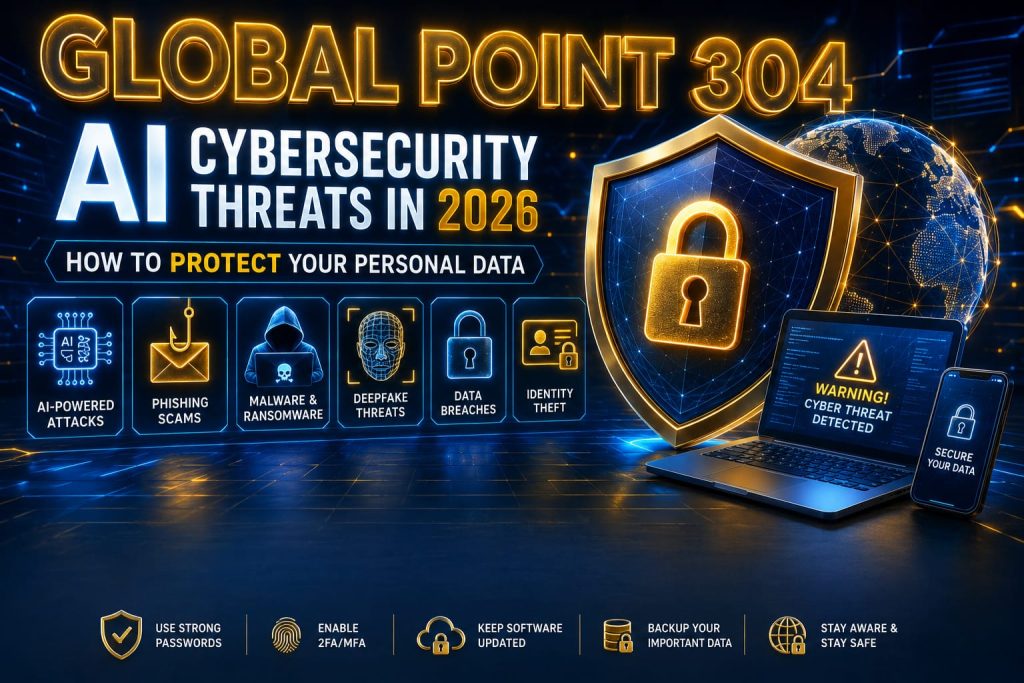
AI Cybersecurity Threats in 2026: How to Protect Your Personal Data
Every year, technology moves faster than most of us can keep up with. In 2026, that speed has a downside. The same artificial intelligence tools that write our emails, edit our photos, and answer our questions are now being used by criminals too. This is why AI Cybersecurity Threats in 2026 have become one of the most talked-about issues in the digital world.
If you use a smartphone, online banking, or social media, you are already part of this conversation whether you realize it or not. Hackers no longer need advanced coding skills to trick people. AI does the heavy lifting for them, writing convincing emails, cloning voices, and even generating fake videos of real people.
At Global Point 304, our goal has always been to break down confusing tech topics into information people can actually use. This guide is a deep, practical look at AI Cybersecurity Threats in 2026, who is most at risk, real examples of AI-powered attacks, and more than twenty steps you can take today to protect your personal data.
What Are AI Cybersecurity Threats?
In simple words, AI cybersecurity threats are cyberattacks that use artificial intelligence to become faster, smarter, and much harder to catch. Older cyberattacks relied on humans doing the work manually. A hacker had to write each phishing email by hand and hope it looked believable.
That is no longer the case. Today, AI tools can generate thousands of unique, personalized scam messages in seconds. This shift is exactly what makes AI Cybersecurity Threats in 2026 so different from the cybercrime of just a few years ago.
AI-powered attacks are now capable of doing things that used to require a whole team of skilled criminals, including:
- Learning from previous failed attacks and improving automatically
- Writing phishing emails that sound completely natural
- Mimicking real human conversations in chat and voice
- Generating fake images, videos, and cloned voices
- Automating password guessing at massive scale
- Scanning millions of devices for weaknesses within minutes
- Adapting instantly when a security system tries to block it
This is why understanding AI Cybersecurity Threats in 2026 is no longer just a topic for IT professionals. It affects anyone with a phone, a bank account, or a social media profile.
Why AI Cybersecurity Matters More Than Ever
Think about how much of your life now lives online. Photos, banking apps, health data, work documents, and private conversations are all stored on connected devices. Every one of these is a possible entry point for someone trying to steal your information.
People today carry personal data across smartphones, smartwatches, cloud storage accounts, smart TVs, home security cameras, digital wallets, and AI assistants. Each device adds convenience, but it also adds risk. This growing web of connected technology is a major reason AI Cybersecurity Threats in 2026 have expanded so quickly.
What makes this moment different is scale. In the past, a hacker might target one victim at a time. Now, with AI automation, a single attacker can run thousands of customized scams in a single hour. Governments, cybersecurity firms, and organizations like the Cybersecurity and Infrastructure Security Agency are actively tracking this shift because the old rules of online safety are no longer enough.
How Artificial Intelligence Changed Cybercrime
To really understand AI Cybersecurity Threats in 2026, it helps to look at exactly what changed. Artificial intelligence did not just make old scams a little better. It rebuilt cybercrime from the ground up.
Faster Attacks
AI systems can scan millions of websites and devices for weak spots in minutes, a process that once took criminals days or even weeks to complete by hand.
Smarter Phishing Emails
Older phishing emails were often easy to spot because of bad grammar or awkward wording. Modern AI writes natural, personalized messages that closely copy the tone of a real bank, employer, or delivery company.
Deepfake Technology
Deepfake tools can create realistic fake videos and cloned audio of real people. Criminals now use this to impersonate company executives, relatives, and even public figures.
Automated Malware
AI allows malicious software to change its own code automatically so that it slips past traditional antivirus tools.
Intelligent Password Guessing
Machine learning models study leaked password databases and predict common patterns far faster than older cracking methods ever could.
Together, these five changes explain why AI Cybersecurity Threats in 2026 feel so different, and so much harder to avoid, compared to the cybercrime of even five years ago.
Top AI Cybersecurity Threats in 2026
AI-Powered Phishing
Phishing is still one of the biggest problems online, and AI has made it worse. Instead of generic messages, AI now builds personalized emails using information pulled from social media, company websites, and public records.
Victims often trust these emails because they include accurate personal details. Common examples of this branch of AI Cybersecurity Threats in 2026 include fake banking alerts, delivery notifications, tax refund messages, fake job offers, and cryptocurrency investment scams.
Deepfake Scams
Deepfake scams are growing faster than almost any other category of cybercrime. Attackers use cloned voices and fake video to impersonate people convincingly.
Common versions include fake CEO video calls, voice-cloned family emergency scams, fraudulent customer support calls, and fake celebrity investment promotions. We covered this in more depth in our earlier piece on AI Scams and Deepfakes in 2026, which pairs well with this guide.
AI-Generated Malware
Cybercriminals now use AI to build malware that changes its own code, avoids detection, learns from failed attempts, and targets specific operating systems. Unlike older viruses, this kind of malware keeps adapting the longer it runs, which is part of what makes AI Cybersecurity Threats in 2026 so hard for regular antivirus software to catch.
Intelligent Password Attacks
Weak passwords are still one of the easiest doors for hackers to open. AI studies billions of leaked passwords to spot predictable patterns, including birth dates, family names, pet names, and simple keyboard sequences.
Using strong, unique passwords along with multi-factor authentication remains one of the best defenses against this specific threat, a point echoed by security guidance from the Federal Trade Commission.
Who Is Most at Risk?
A common myth is that cybercriminals only go after big companies. In reality, individuals are often easier targets because they usually have fewer security layers protecting them. The rise of AI Cybersecurity Threats in 2026 means almost anyone online can become a target.
Students
Students juggle multiple platforms for classes, email, and social media, and many reuse the same password everywhere. Common traps include fake scholarship offers, AI-written university emails, and phishing links disguised as study resources.
Professionals
Remote workers often connect to company systems from home networks. Attackers try to steal business emails, client information, and financial records, frequently starting with an AI-written message that looks like it came from a manager or HR.
Small Business Owners
Small businesses rarely have a dedicated security team, which makes them appealing targets for customer data theft, payment fraud, and stolen tax documents. Understanding AI Cybersecurity Threats in 2026 is becoming essential just to protect customer trust.
Senior Citizens
Older adults are frequently targeted because scammers assume they are less familiar with new AI tools. Fake tech support calls, voice cloning scams, and banking impersonation are especially common here.
Healthcare Users
Anyone using health apps, wearables, or online medical portals may be exposing sensitive health data without realizing it. Protecting this kind of information deserves the same attention as protecting a bank account.
Real-World AI Cyberattack Examples
Reading about these scenarios helps you recognize warning signs before you become a victim yourself.
Voice cloning scam: A parent gets a call that sounds exactly like their child, claiming they were in an accident and need money urgently. AI can clone a voice using only a short clip from social media, which is why verifying through another contact method is so important.
Fake banking email: A message arrives with your real name, the correct bank logo, and recent transaction details, urging immediate login. Once credentials are entered on the fake page, attackers gain full account access.
Fake customer support chat: Scammers build fake support sites powered by AI chatbots that imitate real representatives closely enough to collect passwords and verification codes.
Deepfake business meeting: An employee joins a video call with someone who looks and sounds exactly like the company CEO, requesting an urgent transfer. Without a verification process in place, this kind of AI-generated deception has already cost organizations millions.
Fake investment ads: AI-generated videos of celebrities promote crypto or investment platforms promising unrealistic returns, pressuring people to act before thinking it through.
AI Identity Theft
Identity theft has become one of the fastest-growing outcomes of AI Cybersecurity Threats in 2026. Criminals are no longer satisfied with just a password. They want your complete digital identity.
This can include your full name, date of birth, phone number, email address, government ID details, banking information, and even biometric data like facial images or voice recordings. Once a criminal has enough of these pieces, they can open financial accounts, apply for loans, commit fraud, or impersonate you to access healthcare services.
AI-Powered Social Engineering
Social engineering works by manipulating emotions rather than breaking into a system directly, and AI has made these tricks far more convincing. Attackers commonly play on fear, urgency, curiosity, trust, sympathy, and excitement.
Watch for lines like these, which are classic signs of AI-driven social engineering:
- “Your account will be suspended today”
- “You have won an expensive prize”
- “A family member needs emergency help”
- “Immediate payment is required”
- “Your parcel is waiting for delivery”
A short pause before responding to any unexpected request for money, passwords, or verification codes is one of the simplest ways to avoid falling for this branch of AI Cybersecurity Threats in 2026.
Ransomware Is Getting Smarter
Ransomware keeps evolving alongside everything else on this list. AI-powered ransomware can now identify your most valuable files, encrypt the important documents first, spread automatically across a network, avoid detection, and even calculate the most effective ransom amount based on the victim.
For a business, this can mean financial losses, downtime, reputation damage, and broken customer trust all at once. Regular offline backups remain one of the strongest defenses against this threat, a recommendation also echoed by the National Institute of Standards and Technology.
Risks From Smart Devices
Most homes today are full of connected gadgets: smart TVs, smart speakers, security cameras, smart locks, thermostats, fridges, and fitness trackers. Every single one of these is a potential entry point if it isn’t secured properly.
A few simple habits go a long way here:
- Change default passwords on every new device immediately
- Install firmware updates as soon as they’re available
- Turn off features you don’t actually use
- Use strong Wi-Fi encryption at home
- Keep IoT devices on a separate network from work computers when possible
Protecting Children Online
Kids are growing up surrounded by AI-powered apps, tablets, gaming consoles, and social platforms. Parents can make a real difference by enabling parental controls, reviewing privacy settings together, and having open conversations about scams.
Teaching children to never share personal information online and to report suspicious messages builds habits that protect them for life. This kind of digital safety education is one of the strongest long-term defenses against AI Cybersecurity Threats in 2026 and beyond.
How Global Point 304 Supports Digital Awareness
At Global Point 304, we believe cybersecurity knowledge shouldn’t be locked behind technical jargon. Our aim is to help readers understand emerging technology, recognize evolving risks, and make informed choices that protect their privacy and their digital identity.
Through regularly updated guides on AI, cybersecurity, and health technology, we try to build the kind of awareness that helps individuals, families, students, and small businesses stay a step ahead. If this topic interests you, our earlier article on AI Scams and Deepfakes in 2026 is a good companion read to this guide.
More Practical Ways to Protect Your Personal Data
15. Review Social Media Privacy Settings Regularly
Platforms change their privacy settings often, sometimes resetting them without notice. Check who can see your posts, photos, and personal details every few months.
16. Use a VPN on Public Wi-Fi
Public networks at cafes, airports, and hotels are easy targets for attackers to intercept data. A trusted VPN encrypts your connection and adds an extra layer of protection while you’re out.
17. Monitor Bank and Card Statements
Check your statements often instead of waiting for a monthly summary. Catching a small, unfamiliar charge early can stop a much bigger fraud attempt before it grows.
18. Stay Skeptical of Perfect-Looking Content
If a video, voice message, or investment offer feels too polished or too good to be true, slow down. This instinct is one of your best personal defenses against AI Cybersecurity Threats in 2026.
19. Keep Learning About New Scams
Cybercriminals change their tactics constantly, so staying informed matters. Following trusted sources on AI Cybersecurity Threats in 2026, like this guide, helps you recognize new scams as they appear rather than after you’ve already been affected.
20. Use AI Security Tools to Fight Back
The same technology fueling these attacks is also being used to stop them. Many modern security apps now use AI to detect phishing attempts, flag suspicious logins, and spot malware before it causes damage.
Quick Security Checklist
- Strong, unique passwords for every account
- Multi-factor authentication turned on everywhere possible
- Software and firmware updated regularly
- Emails and links verified before clicking
- Smartphone secured with biometrics and encryption
- Home Wi-Fi protected with strong encryption
- Personal details limited on social media
- Apps downloaded only from trusted stores
- Important data backed up using the 3-2-1 method
- Unusual calls or video requests verified independently
Frequently Asked Questions
Is AI making cybercrime worse?
Yes. AI allows attackers to automate and personalize scams at a scale that simply wasn’t possible before, which is the core reason AI Cybersecurity Threats in 2026 are increasing so quickly.
Can antivirus software stop AI-generated malware?
Good security software still helps, but AI-generated malware can change its own code to slip past older detection methods. Keeping software updated matters more than ever.
How can I tell if a voice or video is a deepfake?
Look for unnatural blinking, odd lighting, mismatched audio, or a request that feels rushed. When in doubt, verify through a separate, trusted communication channel.
Are individuals really at risk, or just big companies?
Individuals are often easier targets precisely because they have fewer defenses in place than large organizations do.
What’s the single most effective step I can take today?
Turning on multi-factor authentication across your important accounts is one of the fastest, highest-impact changes you can make right now.
Final Thoughts
The rise of AI Cybersecurity Threats in 2026 doesn’t mean you need to fear technology. It means you need to use it thoughtfully. Small habits, like strong passwords, careful verification, and a healthy pause before reacting to urgent messages, add up to real protection over time.
Staying aware is the first and most powerful defense you have. At Global Point 304, we’ll keep breaking down topics like this one so you can navigate 2026’s digital world with more confidence and less worry.