Urban Flooding & Groundwater Crisis, Can Underground Tanks Change the Future?

Every monsoon, Pakistan’s big cities face the same problem.
Streets flood, homes fill with water, and traffic stops for hours.
Underneath this, a second crisis is building quietly.
Urban Flooding & Groundwater Crisis are two sides of the same coin.
This post explains why the two problems happen together.
It also looks at how underground tanks can help solve both.
What Is Causing the Flooding
Flooding happens when rain exceeds a city’s drainage capacity.
Water then sits on roads, streets, and inside homes.
Karachi, Lahore, and Islamabad all face worsening floods every year.
Unplanned construction is a major cause of this problem.
Outdated sewerage systems make things worse.
Encroachments on natural waterways add to the trouble too.
Concrete now covers land that once absorbed rainwater.
This is why Urban Flooding & Groundwater Crisis are directly linked.
The Falling Water Table
A falling water table builds up slowly and quietly.
By the time it is visible, the damage has already taken hold.
Most Pakistani cities depend on tube wells for drinking water.
Lahore’s groundwater level has dropped sharply in recent decades.
This trend makes the link between the two problems even more visible.
Extraction now outpaces natural recharge in many cities.
Every study on this topic reaches the same result.
Saving rainwater is the most effective fix.
How the Two Problems Are Connected
Urban Flooding & Groundwater Crisis rarely occur by accident.
Both trace back to poor urban planning.
Concrete keeps rainwater on the surface instead of letting it soak in.
This raises pressure on drains and worsens flooding.
Underground reserves get less natural recharge as a result.
Climate change adds another layer to the problem.
Heavy rain and long dry spells now happen back to back.
Lessons from Other Countries
Singapore’s “ABC Waters Programme” tackles both issues directly.
Rainwater is stored in lakes and underground reservoirs instead of drained away.
Tokyo’s underground “G-Cans” project also controls urban flooding effectively.
Both projects follow one rule: store rainwater, don’t waste it.
This same idea can help solve Urban Flooding & Groundwater Crisis in Pakistan.
Underground Tanks: A Practical Solution
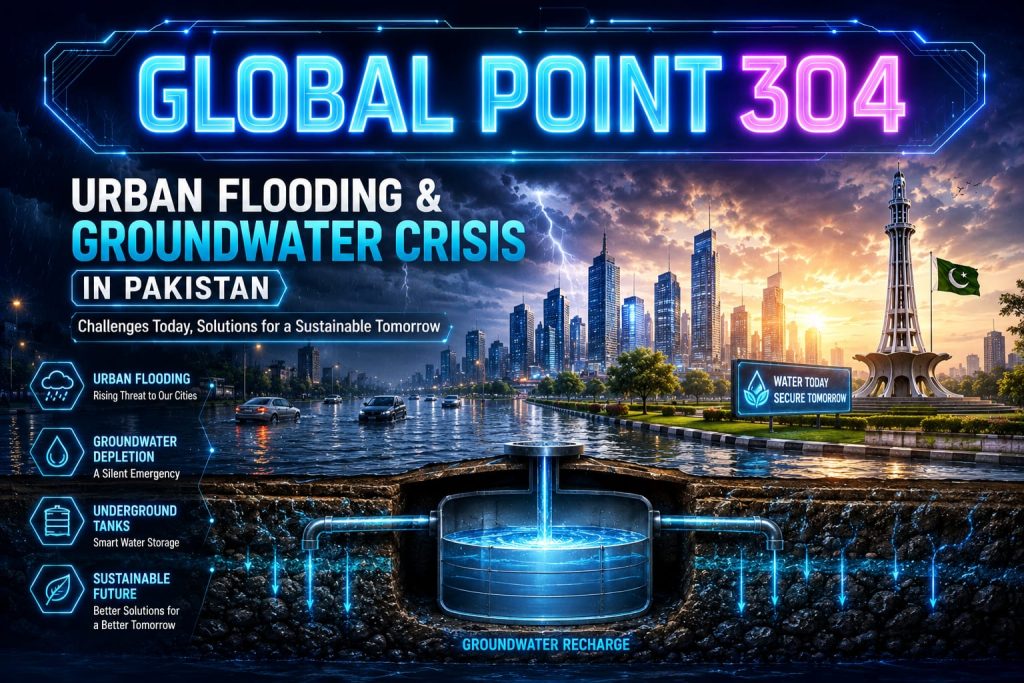
Underground Rainwater Storage Tanks collect water from rooftops and open ground.
This water can be reused at home or released back into the soil.
It is one of the best tools against this crisis.
Tanks are usually built beneath homes, schools, and offices.
They stop water from collecting on streets.
They also help refill the groundwater table.
This is why planners see them as a key part of the solution.
How the Tanks Work
A pipe network first collects water from the roof.
A filtration unit then removes dirt and debris.
Clean water is finally stored underground for later use.
This simple system reduces the impact of both problems.
Solutions for Pakistani Cities
Karachi faces severe flooding every monsoon season.
Mandatory tanks in large buildings could cut the damage sharply.
Lahore’s water table is falling fast.
Rainwater harvesting in housing societies could ease the pressure.
Islamabad’s new societies could require tanks under updated building codes.
This would prevent future Urban Flooding & Groundwater Crisis before it starts.
These steps cost money upfront but save far more in flood damage later.
The Role of Government Policy
Individual effort alone cannot fix this crisis.
Clear government policy is essential.
Mandatory rainwater harvesting in building codes is a strong first step.
Removing encroachments on waterways is equally important.
Modern drainage systems complete the picture.
Together, these steps can turn the tide on the problem.
What Citizens Can Do
Ordinary citizens can also help fight this crisis.
A small rooftop harvesting system is an easy start.
Avoiding waste in drains matters just as much.
Planting trees helps too.
Even a small underground tank at home eases the burden at the neighborhood level.
Climate Change and the Growing Risk
Climate change has made rainfall in Pakistan unpredictable.
Long dry spells and sudden downpours both worsen the situation.
Urban planning must now account for this shift.
We have previously discussed how climate change hits the poorest communities hardest.
This same group suffers most from Urban Flooding & Groundwater Crisis.
Global Point 304’s Efforts
Global Point 304 explains issues like this in simple language.
Our goal is awareness that ordinary readers can act on.
The Social Reforms category covers climate change, poverty, and water scarcity regularly.
Public pressure on policy only grows once awareness grows.
Conclusion
Urban Flooding & Groundwater Crisis are not two separate problems.
They are two symptoms of one crisis.
Underground tanks, better policy, and public awareness together can solve it for good.
The best time to act is now.
For further reading: World Bank Disaster Risk Management and UNEP Water Topic.