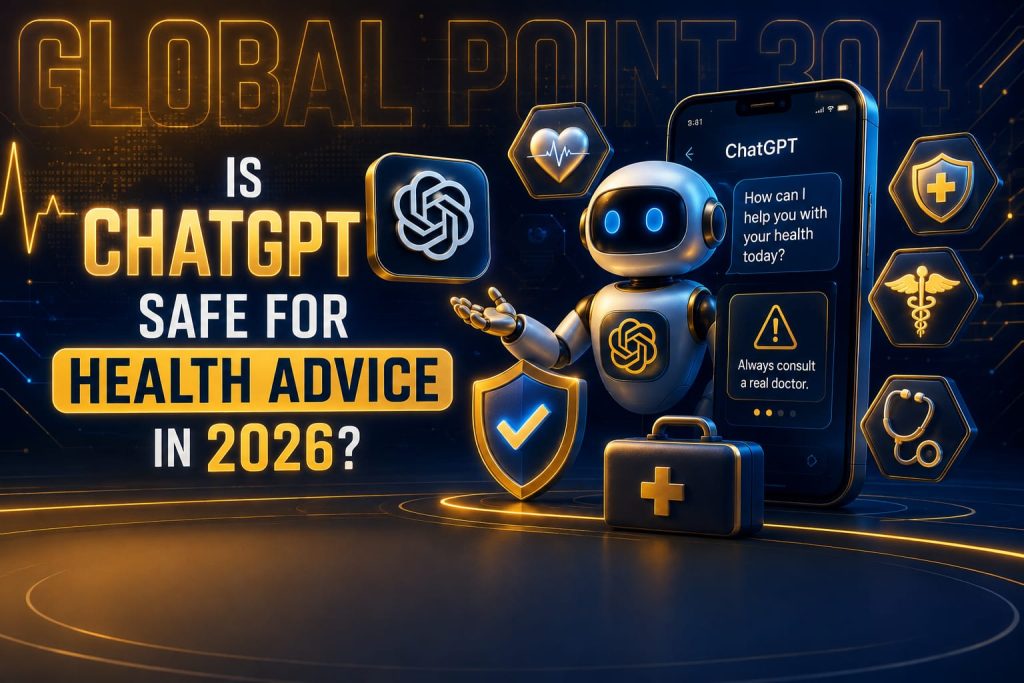
ChatGPT Health Advice 2026: Is It Actually Safe?
It’s late at night. Your stomach hurts, your mind is racing, and the nearest clinic is closed until morning. So you open ChatGPT and type out your symptoms, hoping for a quick answer.
If this sounds familiar, you are part of a massive global shift. ChatGPT health advice 2026 has become one of the most searched topics on the internet, and for good reason. Millions of people now ask AI chatbots about their health before they even think about calling a doctor.
At Global Point 304, we have been tracking this shift closely as part of our ongoing coverage of AI and health technology. What we found while researching ChatGPT health advice 2026 surprised even us, and it is something every reader deserves to know before typing their next symptom into a chatbot.
A Habit That Changed Almost Overnight
Just a few years ago, asking an AI chatbot about a headache or a rash felt strange to most people. Today it feels normal. Search trends for ChatGPT health advice 2026 have climbed sharply, and the reasons are simple.
Doctor visits cost money and time. Waiting rooms are full. Specialists can be hours away, especially outside major cities. An AI chatbot, on the other hand, answers instantly, at any hour, for free.
Why ChatGPT Health Advice 2026 Is Everywhere Right Now
OpenAI itself has reported that over 230 million people now use ChatGPT for health and wellness questions every single week. That is not a small trend anymore. That is a fundamental change in how people relate to their own health.
Part of the reason ChatGPT health advice 2026 has spread so fast is trust built through everyday use. People already ask ChatGPT to write emails, plan trips, and explain complicated topics. Turning to the same tool for a health question feels like a natural next step.
There is also a privacy factor. Some health questions feel embarrassing or personal. Typing them into a chatbot feels safer to many people than saying them out loud to a doctor, even though that sense of safety can be misleading.
Why Global Point 304 Is Covering This Topic
Global Point 304 has spent the past year covering AI, wearables, and digital health for readers in Pakistan and beyond. Through that work, one pattern kept repeating. Readers were increasingly curious, and sometimes worried, about relying on ChatGPT health advice 2026 for real decisions about their bodies.
That curiosity is exactly why this deep dive exists. Rather than simply saying AI is good or bad, this article looks at the actual research behind ChatGPT health advice 2026, so you can make an informed choice the next time you are tempted to ask a chatbot instead of a doctor.
What the Research Actually Shows
This is where ChatGPT health advice 2026 gets far more complicated than most people realize. A major study published in Nature Medicine, conducted by researchers at the Icahn School of Medicine at Mount Sinai, tested how well ChatGPT Health handled real medical triage scenarios.
The results were unsettling. Out of 960 recommendations tested, ChatGPT performed reasonably well for moderate, everyday situations. But at the extremes, the accuracy of ChatGPT health advice 2026 dropped sharply.
For non-urgent situations, the chatbot overreacted 35 percent of the time, telling people to seek care they did not actually need. For genuine emergencies, it failed to recommend urgent care in 48 percent of cases. You can read the full breakdown in this Forbes report on the Nature Medicine study.
In some of the most serious cases tested, including diabetic ketoacidosis and impending respiratory failure, ChatGPT told patients to see a doctor within 24 to 48 hours instead of directing them straight to an emergency room. That is not a small mistake. That is the kind of delay that can cost a life.
It Is Not Just ChatGPT
A separate study published in eClinicalMedicine, part of The Lancet family of journals, tested four major chatbots including ChatGPT, Gemini, Claude, and Llama. Researchers found multiple failures across all of them when answering diagnostic and treatment questions. You can read more in this Lancet eClinicalMedicine analysis.
This matters because it shows the risks around ChatGPT health advice 2026 are not unique to one company or one app. They are built into how these AI systems currently work.
Where ChatGPT Actually Gets It Right
None of this means ChatGPT health advice 2026 is worthless. To be fair, AI performs well in specific, lower stakes situations.
Research on dietary guidance found that ChatGPT gave appropriate nutritional advice for common conditions like high cholesterol and type 2 diabetes in more than half to nearly three quarters of cases, depending on the condition. That is genuinely useful for someone trying to understand general eating habits.
ChatGPT also tends to do well when explaining medical terms in plain language, summarizing well established health information, or helping someone prepare questions before an actual doctor’s appointment. Used this way, ChatGPT health advice 2026 works more like a study partner than a replacement for a physician.
The Confidence Trap
Here is the part that worries researchers the most. A study published in NEJM AI found that people tend to overtrust AI generated medical advice, even when that advice is inaccurate.
This happens because ChatGPT does not sound uncertain. Whether an answer is completely correct or dangerously wrong, it is delivered in the same calm, confident tone. There is no hesitation in its voice, no raised eyebrow, no pause that signals doubt.
A real doctor might say “I am not fully sure, let’s run a test to confirm.” ChatGPT rarely communicates uncertainty that clearly, which is one of the biggest hidden dangers behind ChatGPT health advice 2026 today.
It Does Not Know Your Full Story
A doctor sitting across from you considers your past illnesses, your allergies, the medications you already take, and your recent test results, all at once. ChatGPT only knows what you type into the chat box in that moment.
Most people leave out details without realizing they matter. A minor symptom might seem irrelevant to you but could be a critical clue to a doctor. This gap is one of the quiet weaknesses behind ChatGPT health advice 2026 that rarely gets discussed.
A study on ChatGPT’s performance for cardiovascular patients with multiple existing conditions found that its recommendations became noticeably less reliable as cases grew more complex. In other words, the sicker or more complicated your situation, the less you should trust ChatGPT health advice 2026 on its own.
The Emergency Room Problem
This is arguably the most dangerous gap in ChatGPT health advice 2026. Chest pain, sudden numbness, difficulty breathing, and severe abdominal pain are exactly the kind of symptoms where every minute counts.
As mentioned earlier, ChatGPT failed to recommend urgent care in nearly half of true emergency scenarios tested by Mount Sinai researchers. An AI chatbot cannot take your pulse, listen to your lungs, or call an ambulance. It can only respond to the words you type, and in an emergency, typing calmly is often the last thing your brain is able to do.
When Reassurance Turns Into Anxiety
Type a vague symptom into ChatGPT, and it will often list several possible causes, ranging from mild to serious. For someone who is already anxious about their health, this can backfire badly.
Instead of feeling reassured, many people walk away more frightened than before. This pattern has become common enough that doctors now have a name for excessive, anxious searching of AI tools for symptoms, echoing the older term “cyberchondria” from the Google search era.
This emotional side effect rarely shows up in headlines about ChatGPT health advice 2026, but it is very real for the people experiencing it. If a chatbot’s response leaves you more worried rather than less, that is a signal to close the app and talk to an actual person.
ChatGPT vs Gemini for Health Advice
A common question readers ask Global Point 304 is whether Gemini or ChatGPT is the safer choice for health questions. Based on current research, neither tool stands out as clearly superior.
The Lancet study mentioned earlier tested ChatGPT, Gemini, Claude, and Llama side by side and found meaningful failures across all of them. The takeaway is not that one chatbot is trustworthy while another is not. The real lesson behind ChatGPT health advice 2026 and its competitors is that no general purpose AI chatbot, regardless of brand, should be treated as a medical authority yet.
How to Use ChatGPT Health Advice 2026 Safely
AI chatbots are not going away, and used correctly, they can genuinely help you understand your health better. Here is how Global Point 304 recommends approaching ChatGPT health advice 2026 in a way that protects you rather than puts you at risk.
- Treat it as a starting point, never a diagnosis. Use ChatGPT health advice 2026 to understand terms or prepare questions, then confirm everything with a real doctor.
- Never skip emergency care. Severe, sudden, or worsening symptoms need a hospital, not a chat window.
- Verify medication information separately. Drug dosages and interactions should always be confirmed with a pharmacist or physician.
- Give it as much context as possible. The more accurate details you provide, the more useful ChatGPT health advice 2026 becomes, though it still cannot replace an exam.
- Watch your emotional response. If a chatbot answer increases your anxiety instead of easing it, step away and speak to a person you trust.
What This Means for Readers in Pakistan
For many readers of Global Point 304, the appeal of ChatGPT health advice 2026 is especially strong. Specialist doctors are often concentrated in major cities, appointment costs add up quickly, and late night access to a real physician is not always realistic.
In this context, ChatGPT can be a genuinely helpful bridge, especially for understanding symptoms, medicines, or lab results in simple language. But the same rule applies here as everywhere else. It should guide you toward proper care, not replace it.
Related Reads on Global Point 304
If this deep dive into ChatGPT health advice 2026 was useful, these related articles from Global Point 304 dig deeper into the health and technology topics that connect to it.
- How Social Media Is Affecting Youth Mental Health in 2026
- Vitamin D Deficiency: Symptoms and Causes You Should Not Ignore
- Walking vs Running for Weight Loss in 2026
- 5G and Health: Harmful or Beneficial?
Together, these pieces reflect the same goal behind this article. Global Point 304 wants readers to understand new technology clearly enough to use it wisely, not fear it or follow it blindly.
Frequently Asked Questions About ChatGPT Health Advice 2026
Is ChatGPT health advice 2026 accurate enough to trust?
It depends heavily on the situation. Research shows ChatGPT performs reasonably well for common, moderate risk questions but becomes far less reliable at the extremes, especially in emergencies and complex medical cases.
Can ChatGPT replace a doctor in 2026?
No. Despite how far ChatGPT health advice 2026 has come, it cannot examine you, order tests, or access your full medical history. It works best as a starting point, not a final answer.
Is Gemini safer than ChatGPT for health questions?
Not clearly. Studies comparing multiple chatbots, including Gemini and ChatGPT, found meaningful accuracy failures across all of them, not just one platform.
What should I never ask ChatGPT during a medical emergency?
Do not use ChatGPT health advice 2026 to decide whether to go to a hospital. If you suspect chest pain, breathing difficulty, or any severe symptom, seek emergency care immediately instead of typing it into a chatbot.
The Bottom Line on ChatGPT Health Advice 2026
ChatGPT health advice 2026 is not a passing trend. It reflects a real shift in how people around the world, including here in Pakistan, are choosing to understand their health.
Used thoughtfully, it can help you learn, prepare, and ask better questions. Used carelessly, especially during an emergency or a complex condition, it can lead you dangerously astray.
The smartest approach in 2026 is not choosing between AI and real medical care. It is using ChatGPT health advice 2026 to walk into the doctor’s office more informed, never to avoid walking in at all. At Global Point 304, we will keep tracking how this technology evolves, so you always have the facts before you decide who, or what, to trust with your health.
This article is for general informational purposes only and is not a substitute for professional medical advice, diagnosis, or treatment. Always consult a qualified healthcare provider for any health concerns.