Artificial intelligence has moved from experimental technology to an everyday part of digital life. In 2026, people use AI for writing, research, coding, customer support, education, productivity, search, business automation, and many other tasks
But as AI becomes more common, one problem has become increasingly noticeable: people often use the terms AI agent, chatbot, and LLM as if they mean the same thing
They do not
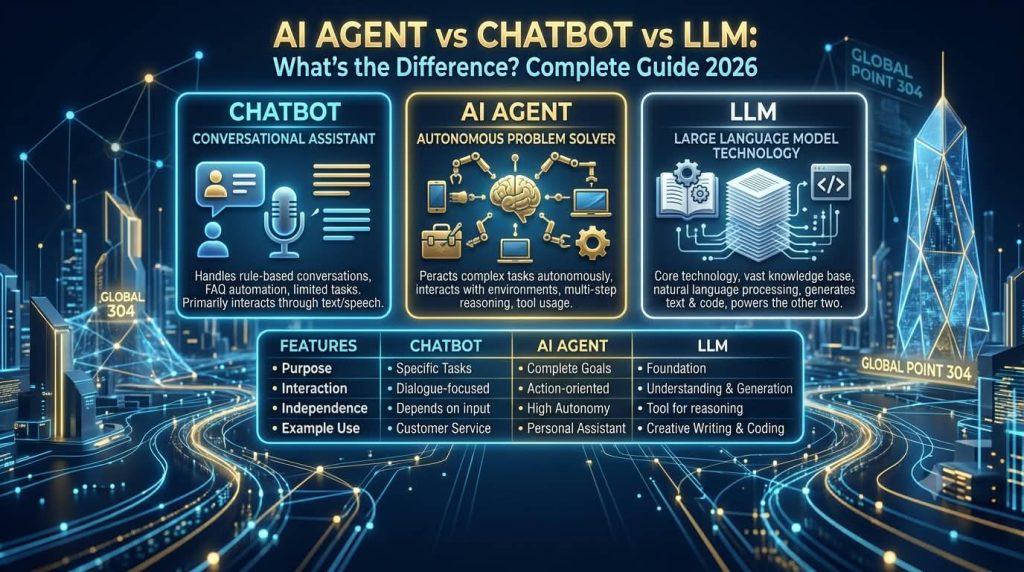
An LLM can generate language and reason over information. A chatbot provides a conversational interface. An AI agent can use models, memory, tools, and workflows to pursue a goal and perform actions
That distinction matters
If you are a student, developer, business owner, content creator, technology enthusiast, or someone simply trying to understand modern AI, knowing the difference can help you choose the right technology
This complete AI Agent vs Chatbot vs LLM guide explains the differences in simple language, explores how the technologies work together, examines practical use cases, discusses security and cost considerations, and looks at where AI is heading beyond 2026
Quick Answer: AI Agent vs Chatbot vs LLM
The easiest way to understand the three technologies is to think about them as different parts of an AI-powered system
An LLM, or Large Language Model, is the underlying model that processes language and generates responses. It can summarize information, write text, translate languages, explain concepts, generate code, and perform many reasoning-oriented tasks
A chatbot is an application or conversational interface through which a person interacts with software using text or voice. A chatbot may use an LLM, but not every chatbot requires an LLM. Traditional chatbots can also operate through predefined rules
An AI agent is a more action-oriented system. It can use an LLM as its reasoning engine while also using memory, tools, APIs, planning mechanisms, and external systems to accomplish a goal
In simple terms
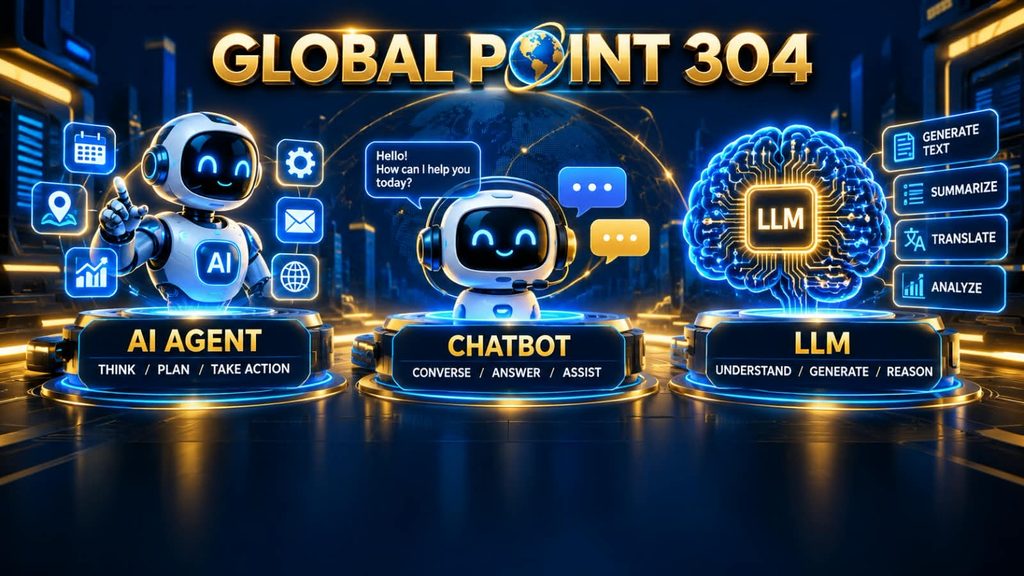
LLM = thinks and generates
Chatbot = communicates
AI agent = works toward a goal and can take actions
This simple model is useful, although real-world systems can be more complicated
Why the Difference Matters in 2026
The difference between an AI Agent vs Chatbot vs LLM is no longer just a technical vocabulary issue
Businesses are increasingly connecting AI systems to databases, software applications, customer support platforms, calendars, websites, development environments, and other tools
That creates a major difference between a system that simply produces an answer and a system that can actually perform a workflow
For example, imagine asking an AI
“Find three suitable meeting times next week, check my calendar, prepare an invitation, and send it after I approve it”
A basic LLM can help draft the invitation
A chatbot can provide a conversational interface for the request
An AI agent may be designed to check calendars, compare availability, prepare the invitation, request approval, and then send it through an integrated service.
This is why understanding AI Agent vs Chatbot vs LLM is increasingly important for modern technology decisions
For a broader look at the development of artificial intelligence, readers can also explore Global Point 304’s article on The Global AI Revolution in 2026
What Is an LLM?
LLM stands for Large Language Model
An LLM is a type of AI model trained on large datasets so that it can process and generate language. Modern models can also work with other modalities depending on their architecture and capabilities
When you type a question into an AI system, the underlying model processes your instructions and generates a response based on patterns learned during training and information available through its current context or connected tools
LLMs are often used for
• Writing and editing
• Summarization
• Translation
• Coding assistance
• Question answering
• Brainstorming
• Classification
• Information extraction
• Reasoning tasks
• Content generation
The important point is that an LLM by itself is not automatically an autonomous agent
An LLM can produce an excellent answer without having permission to access your calendar, modify your database, send an email, or purchase something online
That distinction is central to the AI Agent vs Chatbot vs LLM discussion
How an LLM Works at a High Level
An LLM receives an input and processes it using its learned parameters and current context
For example, if you ask
Explain cloud computing to a beginner
The model generates an explanation based on patterns and knowledge represented within the model and the information supplied to it
However, an LLM does not automatically know everything happening in the outside world at the moment you ask a question
Fresh information may require retrieval systems, web access, databases, APIs, or other tools
This is one reason modern AI architectures increasingly combine language models with external systems
For more information about artificial intelligence research and education, readers can explore the Stanford AI Laboratory
Researchers can also explore AI and machine learning papers through arXiv Computer Science
What Is a Chatbot?
A chatbot is a software application designed to communicate with users through a conversational interface
The conversation may happen through a website, mobile application, messaging platform, customer support portal, or another digital channel
Chatbots existed long before today’s generative AI boom
Traditional chatbots often used predefined rules
For example
User “What are your opening hours?”
Bot “Our office is open from 9 AM to 5 PM”
If the user asked something outside the predefined decision tree, the chatbot might not know how to respond
Modern AI-powered chatbots can be much more flexible because they can use LLMs and natural language processing
IBM describes chatbots as software applications that communicate through text or voice, while noting that traditional chatbots can use predefined rules and AI chatbots can use technologies such as NLP, generative AI, and LLMs
Types of Chatbots
There are several broad categories
Rule-Based Chatbots
These follow predetermined flows
They are useful for predictable questions, navigation, frequently asked questions, and basic customer service
They are usually easier to control because their responses and actions are predefined
AI-Powered Chatbots
These use AI models to understand more flexible user questions
They can answer questions in natural language and maintain conversational context
Examples include AI assistants integrated into websites, applications, and productivity platforms
LLM-Powered Chatbots
These use a large language model as a core component
They can produce more natural responses and handle a wider range of language than traditional rule-based systems
However, using an LLM does not automatically turn a chatbot into an AI agent
That is another important point in the AI Agent vs Chatbot vs LLM comparison
What Is an AI Agent?
An AI agent is a system designed to pursue a goal by reasoning about tasks and using available tools or actions
IBM describes AI agents as systems that can autonomously perform tasks by designing workflows with available tools. OpenAI similarly describes agents as systems capable of performing workflows on a user’s behalf with a high degree of independence
An AI agent may include several components
These can include
• An LLM
• Memory
• Planning mechanisms
• Tool access
• APIs
• Databases
• Retrieval systems
• Workflow orchestration
• Monitoring
• Permission controls
• Human approval steps
The exact architecture varies according to the application
An agent does not necessarily need unlimited autonomy.
In fact, well-designed systems often deliberately limit what an agent can do
For example, an agent might be allowed to prepare a financial transaction but require a human to approve the transaction before it is executed
AI Agent vs Chatbot vs LLM: The Core Difference
The simplest distinction is based on function
An LLM is primarily the model
A chatbot is primarily the conversational application
An AI agent is primarily the goal-oriented execution system
This means the three can exist together
A modern AI application might contain all three
User → Chatbot Interface → AI Agent → LLM → Tools and APIs
The user interacts with the chatbot
The agent decides what needs to happen
The LLM helps interpret instructions and generate reasoning or content.
The tools perform external operations
This architecture explains why the terms are often confused
AI Agent vs Chatbot vs LLM Comparison Table
| Feature | LLM | Chatbot | AI Agent |
|---|---|---|---|
| Main purpose | Language and reasoning | Conversation | Goal-oriented task execution |
| User interface | Not necessarily | Usually conversational | May be conversational or invisible |
| Autonomy | Usually limited by application | Usually responds to users | Can operate through multi-step workflows |
| Tool use | Requires integration | May have tools | Commonly designed around tools |
| Memory | Context dependent | May maintain conversation state | Often includes persistent state or memory |
| Planning | Model-dependent | Usually limited | Often central to workflow |
| External actions | Not by itself | Depends on integrations | Core capability in many designs |
| Example | Generate an explanation | Answer customer questions | Resolve a multi-step support workflow |
The table should not be interpreted as an absolute technical rule
Modern AI systems increasingly blur these categories
Some chatbots can call tools
Some LLM applications have memory
Some agents use deterministic software alongside AI models
The purpose of the comparison is to understand the dominant role each component plays
How AI Agents, Chatbots, and LLMs Work Together
A useful example is customer support
Imagine a customer writes
“I received the wrong product. Please check my order and help me get a replacement”
The chatbot receives the message
The LLM can understand the customer’s intent and summarize the problem
The AI agent can potentially check the order system, verify eligibility, locate the relevant product information, create a replacement request, update internal systems, and prepare a response
The workflow might look like this:
Customer
↓
Chatbot Interface
↓
AI Agent
↓
LLM
↓
Business Tools and APIs
↓
Database / CRM / Order System
↓
Customer Response
This is much more powerful than simply generating a paragraph
It is a workflow
AI Agents and Tool Use
Tool use is one of the most important differences when studying AI Agent vs Chatbot vs LLM
A model can generate text
An application can display text
An agent can potentially use software tools to accomplish tasks
Tools might include
• Web search
• Databases
• APIs
• Email systems
• Calendars
• Payment platforms
• CRM systems
• Code execution environments
• Cloud services
• File systems
• Business applications
The agent determines when a tool may be needed and passes information to the appropriate system
However, tool access must be controlled carefully
An AI system should not automatically receive unlimited permissions simply because it can use tools
Memory: Another Important Difference
Memory is another area where these systems can differ
An LLM receives context supplied to it
A chatbot may remember previous messages during a conversation
An agent can be designed with more persistent state, allowing it to track information across a longer workflow or multiple interactions
Memory can improve personalization and workflow continuity
But memory also introduces privacy and security considerations
For example, an organization needs to determine
What information should be stored?
How long should it be stored?
Who can access it?
Can users delete it?
How is sensitive information protected?
These questions become increasingly important as AI systems move from simple conversations toward long-running workflows
AI Agent vs Chatbot vs LLM in Customer Support
Customer support is one of the clearest examples
An LLM can summarize a support ticket
A chatbot can answer frequently asked questions
An AI agent can potentially coordinate multiple steps in a support workflow
For example, an agent might
- Read the customer’s request
- Identify the relevant order
- Check company policy
- Query an internal system
- Determine whether the requested action is permitted
- Prepare the next step
- Request human approval when required
- Update the support record
- Send a response
The exact capabilities depend entirely on the software integrations and permissions provided to the system
AI Agent vs Chatbot vs LLM in Software Development
Software development is another major area of interest
An LLM can explain code
It can generate functions, suggest fixes, write documentation, or help developers understand unfamiliar syntax
A chatbot can provide a conversational interface for those capabilities
An AI agent can potentially interact with repositories, development environments, testing systems, issue trackers, and other software tools
For example, an agent-based development workflow could involve
Reading a GitHub issue
Inspecting relevant files
Proposing a code change
Running tests
Reviewing test results
Making corrections
Preparing a pull request
Human review can then remain part of the process
This model is becoming particularly important as AI coding systems evolve
OpenAI’s current agent guidance emphasizes multi-step tasks, tool use, orchestration, and safety considerations when designing agents
AI Agents for Students and Researchers
Students may interact with AI every day
An LLM can explain a difficult concept
A chatbot can act as a conversational study partner
An AI agent can potentially coordinate a larger workflow involving research, notes, files, calendars, or other connected tools
For example, a research workflow could involve
Finding relevant papers
Extracting key information
Organizing references
Creating structured notes
Building a research schedule
Preparing questions for further investigation
However, students should verify important information rather than assuming AI-generated material is automatically accurate
For more practical examples, see Global Point 304’s guide to AI Tools for Students in 2026
AI Agent vs Chatbot vs LLM for Business
Businesses should start with the problem rather than the technology
Instead of asking
“Should we buy an AI agent?”
Ask
“What process are we trying to improve?”
A simple FAQ may only require a chatbot
A document summarization workflow may require an LLM-powered application
A complex multi-step business process may benefit from an agent architecture
This approach can reduce unnecessary complexity
It can also make implementation easier to measure
Cost Considerations
Cost is an important factor in the AI Agent vs Chatbot vs LLM comparison
A simple chatbot may perform one model request per interaction
An agent can potentially perform several model calls and tool calls during a single task
That can increase
• API usage
• Infrastructure costs
• Latency
• Monitoring requirements
• Storage requirements
• Engineering complexity
For businesses, the correct question is therefore not simply “Which AI is more advanced?”
It is
“What level of capability is justified by the business problem?”
Cloud Computing and AI Infrastructure
Large-scale AI systems require infrastructure
LLM applications may need model APIs, GPUs, storage, networking, databases, retrieval systems, and monitoring
Agent systems can add another layer of complexity because they may execute multiple tools and workflows
Global Point 304 has also covered the regional infrastructure side of this topic in its guide to Cloud Computing in Pakistan in 2026
Cloud infrastructure can be especially important for businesses that need scalable AI applications without building every component themselves
For enterprise AI infrastructure information, readers can explore AWS AI solutions and Microsoft Azure AI
Security Risks of AI Agents
Greater capability can also mean greater risk
A chatbot that only answers questions may have limited permissions
An agent connected to business systems may have permission to perform actions
That changes the security equation
Potential risks include
• Prompt injection
• Unauthorized tool use
• Data leakage
• Excessive permissions
• Credential exposure
• Malicious instructions
• Unsafe automation
• Incorrect actions
• Poorly controlled access to sensitive systems
NIST’s Generative AI Profile identifies risks associated with generative AI and provides guidance for organizations seeking to manage those risks across the AI lifecycle
Global Point 304 also covers this subject through its articles on AI Scams and Deepfakes in 2026 and AI Cybersecurity Threats in 2026
Why Human Oversight Still Matters
AI agents should not automatically receive unrestricted control over sensitive systems
Human approval can be particularly useful for
Financial transactions
Legal decisions
Sensitive data access
Permanent database changes
Account deletion
High-value purchases
Security changes
Critical infrastructure operations
A human-in-the-loop design allows AI to perform useful preparation and automation while reserving sensitive decisions or actions for authorized people
This is an important part of responsible AI deployment
AI Agent vs Chatbot vs LLM and Privacy
Privacy should be considered at the architecture stage
Organizations should understand where prompts, files, conversations, and tool outputs are processed and stored
Before connecting an AI system to private company data, businesses should evaluate
Data retention
Access control
Encryption
Vendor policies
Authentication
Audit logging
Third-party integrations
Regulatory requirements
Employee access
The more connected an AI system becomes, the more important these controls become
AI Search, SEO, AEO, and GEO
The evolution from traditional search toward AI-powered search is changing how websites present information
Traditional SEO focuses heavily on visibility in search engine results
Answer Engine Optimization, often abbreviated as AEO, focuses on creating content that can provide direct answers
Generative Engine Optimization, or GEO, is commonly used to describe efforts to make content understandable and useful for generative AI systems
These approaches overlap, but they are not identical
Global Point 304 explores this changing environment in its guide to AEO vs SEO vs GEO in 2026 and its analysis of AI Search vs Google Search in 2026
For publishers, the practical lesson is simple
Create content for humans first
Use clear headings
Answer specific questions
Explain concepts accurately
Add useful examples
Cite trustworthy sources
Build relevant internal links
Keep information updated
Avoid unnecessary repetition
This approach can make an article more useful across conventional search, AI-assisted discovery, and social sharing
AI Agent vs Chatbot vs LLM for Everyday Life
These technologies are already relevant to everyday activities
Consider meal planning
An LLM can suggest recipes
A chatbot can discuss dinner ideas
An AI agent could potentially coordinate a weekly plan, grocery list, calendar, and ordering workflow when appropriate integrations are available
Global Point 304 has explored this subject through its guide to Best AI Recipe Generators in 2026 and its comparison of AI Meal Planner vs Traditional Meal Planning
Productivity provides another example
An LLM can help write an email
A chatbot can help you discuss what the email should say
An agent could potentially coordinate tasks across a calendar, email platform, project management system, and document workspace
The technology becomes more powerful as integrations increase
But so does the importance of permissions and oversight
AI in Health Applications
Healthcare is a particularly sensitive area
An LLM can explain general health information
A chatbot can provide conversational educational information
An AI agent could potentially interact with scheduling systems or other healthcare software when properly designed and authorized
However, medical decisions require additional safeguards
AI-generated health information should not automatically be treated as professional medical diagnosis or treatment
Global Point 304 has discussed this subject in its article ChatGPT Health Advice 2026: Is It Actually Safe?
The key lesson is that greater automation does not remove the need for professional judgment
AI Agent vs Chatbot vs LLM: Common Misconceptions
Misconception 1: Every chatbot is an AI agent
Not true
A chatbot may simply answer questions through a conversational interface
Some chatbots have tools and automation, but the word chatbot itself does not guarantee autonomous task execution
Misconception 2: Every LLM is an agent
Not true
An LLM is a model
It can become part of an agent architecture, but the model alone does not define the entire agent system
Misconception 3: Agents always work without humans
Not necessarily
Agent systems can include approval checkpoints and human oversight
The degree of autonomy depends on the system design
Misconception 4: More autonomy is always better
More autonomy can introduce additional risk and complexity
For some tasks, a simple deterministic workflow may be more appropriate
For others, an agent can provide meaningful automation
The right architecture depends on the task
When Should You Use an LLM?
An LLM may be suitable when the primary requirement is language or reasoning
Examples include
Writing
Summarization
Translation
Content analysis
Code explanation
Brainstorming
Classification
Question answering
If the system does not need to perform external actions, a full agent architecture may not be necessary
When Should You Use a Chatbot?
A chatbot is useful when conversation is the main interaction model
Examples include
Customer FAQs
Website assistance
Basic support
Product information
Educational Q&A
Appointment inquiries
Internal employee assistance
A chatbot can be powered by an LLM or by traditional rules
When Should You Use an AI Agent?
An AI agent becomes more relevant when the task involves multiple steps and external actions
Examples may include
Workflow automation
Software development assistance
Research workflows
Customer service automation
Scheduling
Business process coordination
Data processing
IT operations
The agent needs appropriate tools, permissions, monitoring, and safeguards
A Practical Decision Framework
Before implementing AI, ask five questions
Question 1: Does the system only need to generate information?
If yes, an LLM-based application may be sufficient
Question 2: Does the user need a conversational interface?
If yes, a chatbot layer may make sense
Question 3: Does the system need to perform several steps?
If yes, consider an agent or workflow orchestration system
Question 4: Does it need external tools?
If yes, design secure tool integrations
Question 5: Can an incorrect action cause serious harm?
If yes, introduce stronger validation, permissions, monitoring, and human approval
This framework can prevent businesses from adopting unnecessarily complicated AI systems
Leading AI Platforms and the Changing AI Landscape
The AI ecosystem in 2026 includes major commercial model providers, cloud platforms, open-source models, specialized AI applications, and agent frameworks
The exact capabilities change rapidly
For a broader comparison of major conversational AI platforms, see Global Point 304’s ChatGPT vs Claude vs Grok vs Gemini guide
Global Point 304 has also covered developments around Gemini and its expanding user ecosystem in Gemini and the Future of AI
Readers interested in broader AI software can explore Best AI Tools in 2026
The Future of AI Agents
The distinction between an LLM, chatbot, and agent may become less visible to everyday users
Users may simply say what they want
The underlying system could decide whether it needs
An LLM
A retrieval system
A chatbot interface
An agent
A database
An API
A specialized model
A human approval step
This means the future AI experience may be less about choosing a specific technical component and more about expressing a goal
However, that does not mean the underlying distinctions will disappear
Developers and organizations will still need to understand the architecture
They will need to know which component generates information, which component manages interaction, which component performs actions, and which permissions are available
Recent developments in the agent ecosystem show how quickly this area is evolving. For example, OpenAI announced its Agents API in September 2026, describing infrastructure for long-running agents, tool use, context management, and coordination
Multi-Agent Systems
Another emerging concept is the multi-agent system
Instead of one agent handling every task, different specialized agents can potentially work together
For example
A research agent could gather information
A coding agent could modify software
A testing agent could evaluate the changes
A project agent could coordinate the workflow
This architecture can be powerful, but it also creates additional challenges
Communication between agents must be controlled
Permissions must be carefully designed
Errors can propagate from one system to another
Monitoring becomes more important
Organizations therefore need to evaluate whether multi-agent architecture actually adds value for their use case
How Global Point 304 Fits Into the AI Conversation
Global Point 304 is building an ongoing technology knowledge base around artificial intelligence, search, cybersecurity, cloud computing, productivity, and emerging digital tools
The goal is to make complicated technology topics easier to understand through practical explanations and accessible guides
This article continues that effort by explaining one of the most frequently misunderstood AI concepts in 2026
Readers can continue exploring related Global Point 304 resources, including
Agentic AI in 2026 and Autonomous Agents
ChatGPT vs Claude vs Grok vs Gemini
AI Cybersecurity Threats in 2026
Best Productivity Apps in 2026
These related articles create a connected AI and technology content cluster that can help readers discover additional information
AI Agent vs Chatbot vs LLM: Frequently Asked Questions
Is ChatGPT an LLM or a chatbot?
The answer depends on what part of the system you are describing
The underlying model is an LLM, while ChatGPT is an AI application and conversational interface built around AI models and additional capabilities
Therefore, describing the entire product simply as “an LLM” does not capture the complete system
Is an AI agent the same as a chatbot?
No
A chatbot focuses primarily on conversational interaction
An AI agent can use conversation as its interface, but its defining characteristic is its ability to pursue goals through workflows and tools
Can an LLM become an AI agent?
An LLM can serve as the reasoning component of an AI agent
Additional software is needed for things such as tool access, orchestration, memory, state management, permissions, and execution
Are AI agents always autonomous?
No
The level of autonomy can vary
Some systems can operate independently for certain tasks, while others require human approval at important stages
Are AI agents more expensive than chatbots?
They can be
An agent may make multiple model and tool calls during one task
Actual costs depend on the model, architecture, usage, infrastructure, and integrations
Do chatbots always use LLMs?
No
Traditional chatbots can operate through predefined rules
Modern AI chatbots frequently use LLMs, but the terms are not synonymous
Why are AI agents important in 2026?
Because they extend AI from generating information toward performing multi-step workflows
As businesses connect AI to more software systems, agent-style architectures are becoming increasingly relevant
Final Thoughts
The simplest way to remember AI Agent vs Chatbot vs LLM is this
An LLM is the model that can process language and generate information
A chatbot is a conversational application that allows people to interact with software
An AI agent is a goal-oriented system that can combine models with memory, planning, tools, and external systems to perform tasks
The three technologies are not competitors in every situation
They can be components of the same system
An LLM can power a chatbot
A chatbot can provide the interface for an AI agent
An AI agent can use an LLM as its reasoning engine
Understanding this relationship makes it easier to evaluate AI products, plan business automation, understand new technology announcements, and make informed decisions about AI implementation
The future of artificial intelligence will likely involve increasingly capable combinations of models, applications, tools, and automated workflows
But capability should always be matched with appropriate security, privacy, reliability, and human oversight
For readers following these changes, Global Point 304 will continue covering developments across artificial intelligence, cybersecurity, cloud computing, search technology, productivity, and emerging digital tools
The AI landscape is changing quickly
Understanding the difference between an LLM, a chatbot, and an AI agent is a useful first step toward understanding where that landscape is heading next
Authoritative External Resources
For readers who want to explore the subject further
• OpenAI: A Practical Guide to Building AI Agents
• NIST: Artificial Intelligence Risk Management Framework
These resources provide additional technical and risk-management context for understanding modern AI systems